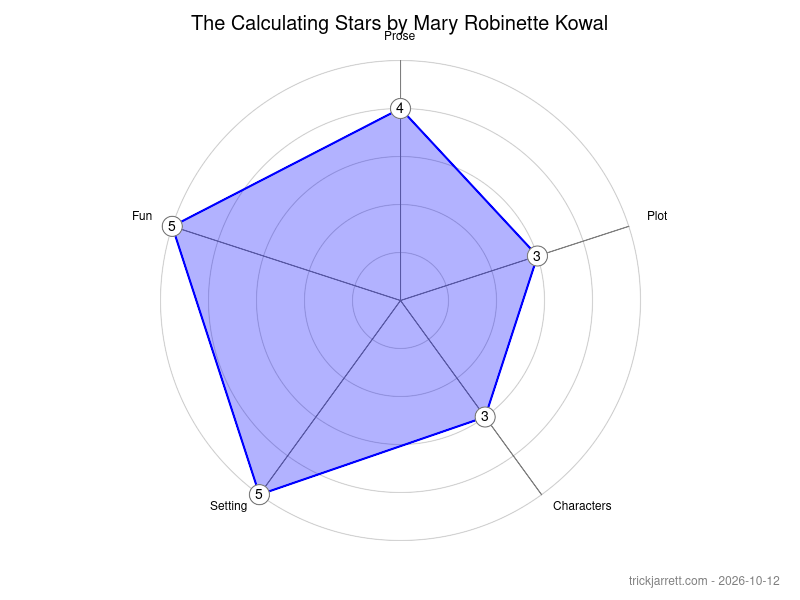
The Calculating Stars - 4 out of 5 Stars
10/12/2026 7:31 am | Share to: 

Finished Mary Robinette Kowal's 2018 The Calculating Stars last night and overall I enjoyed it! It wasn't perfect, but it had a lot that I liked.
Open the book with a global disaster movie, then combine Andy Weir's Project Hail Mary with elements of Margot Lee Shetterly's Hidden Figures, which inspired the movie about the calculators of early NASA, and you get the base recipe of this book.
The story opens with the question: How would the world react if Earth was hit by an extinction-level meteor in the 1950s, before we have even been to space yet at all?
We see a glimpse of things we're seeing today, such as global unification into an International Space Agency of sorts, as well as American politics, and even climate deniers, all make their presences known as part of the story.
We follow Elma York, a genius mathematician who was a WASP during World War II and her husband, Nathaniel, who both find themselves thrust into being part of the global effort to get to space to set about colonizing other planets. The story faces the times and explores: sexism, racism, antisemitism, and more, including Elma having to recognize her own internalized racism.
There are frequent time jumps in the story as we progress years from the inciting meteor impact to the world making it to space. Often these time jumps felt like Kowal, in the effort to simplify the story, would jump time and jump to events rather than lingering on the journey Elma was going through. The book could easily have been twice as long and I think in many ways I probably would have enjoyed it more had it been.
This book falls into the competency-porn genre, alongside Andy Weir's writings. The main character is a genius and spends the story convincing others that she can be an astronaut. She is the person who realizes the true danger of the meteor and that it poses an existential threat to humanity. She, multiple times, does complicated math that is critical to the space mission. She is a person who reading on a page I ask "why don't they just listen to her?" -- and that is the entire point. The sexism she faces, even as men around her acknowledge her as extraordinary, IS the point of the story.
I won't recount the full plot, though this leads me to my core criticisms of the book, which require spoilers for me to discuss.
Spoilers warning about the wrap up of the book:
There are two men in the space program who make clear to Elma that she won't be an astronette. One does so out of sexism, and one for a past event that Elma did which the other man takes personal.
The first man is the head of the space program. He and Elma had crossed paths during the war and it turns out Elma's father had been a General during the war. We don't get the details of what happened but the man had done something and she had reported him for it. An act he held an unbreakable anger towards her for and he swears she would never go to space because of it. Elma had turned to publicity and the press in her efforts to get women (and herself) accepted as astronauts. Her campaign and her fame grew, even being called "lady astronaut" by newspapers, Life magazine, and as a guest on Mr. Wizard. This publicity and public pressure overcame his ability to deny her the role, and it was almost that he was simply left behind. No concluding confrontation. No justice meted out, beyond the act of succeeding despite him.
The second of the men is a Neal Armstrong stand-in, and the conflict centers around sexism and the fact that Elma has anxiety attacks and is prescribed a drug, Miltown. She keeps the medication a secret afraid it will keep her from potentially going to space, giving him power over her for risk of exposing her. This, and his sexism, lead him to claim she can't be trusted on a mission in case she suffers an anxiety attack in a crucial moment. It's a looming threat for much of the book. And then, when he attempts to actually use this and block her from succeeding, after all the fear and focus that has been spent on it - we suddenly find no one around her cares. She doesn't outsmart him. It just... fails.
On the one hand - it's a good message, perhaps fitting as commentary on our own mental battles against imagined evils. But, for it to disappear so easily after having been one of the major concerns of going to space left me feeling unfulfilled and disappointed.
The majority of this has been my criticisms of the book despite my giving it a high rating. I really did enjoy it and came back eager to read each chapter. The story has a lot of charm and I will check out its sequel in the future.
Giving both Characters and Plot 3's feels harsh but its where I land. The vast majority of the characters in the story are 5's, but there are some real stinkers here that I struggled with. A few key moments felt like the characters were acting purely as Kowal needed and not because of realistic and believable narrative. Looking past those though, there are several characters I adore including Elma and her core cadre.
The plot being the other mid-mark is explained with both my above spoiler laden criticisms but also because of the time jumps I mention above. There were several times I wished to see and understand more of the journey. As I think on it more, I think the criticisms I hold to this book heavily come down to what isn't there. Perhaps the editors took too much away? Who's to say.
But if my criticism of a good book is I wanted more, then it's a sign of a great book.