"Fossilized footprints reveal 2 extinct hominin species living side by side 1.5 million years ago"
This is the first time ever that scientists have been able to say that Homo erectus and Paranthropus boisei – one our likely ancestor and the other a more distant relative – actually coexisted at the same time and place. Along with many different species of mammals, they were both members of the ancient community that inhabited the Turkana Basin.
Not only that, but with the new tracks as references, our analyses suggest that other previously described hominin tracks in the same region indicate that these two hominins coexisted in this area of the Turkana Basin for at least 200,000 years, repeatedly leaving their footprints in the shallow lake margin habitat.
Very exciting and interesting stuff as a discovery.

 |
|
 Delving into the meaning of the Ubuntu philosophy
Bringing people together is what i call 'ubuntu,' which means 'I am because we are.' Far too often people think of themselves as just individuals, separated from one another, whereas you are connected and what you do affects the whole world. When you do well, it spreads out; it is for the whole of humanity. - Desmond Tutu
I have known of the term of ubuntu for years. Largely since it's rise as the name of a Linux distro in the 2000s. However I was re-introduced to it for its philosophical meaning as I continue listening to 'How to be Perfect.'
Ubuntu is an Nguni Bantu term meaning "humanity". And the philosophy it represents, as Desmond Tutu speaks to above, is "I am because we are." Which I absolutely adore.
From its Wikipedia page, the most recent definition of ubuntu from the African Journal of Social Work:
A collection of values and practices that people of Africa or of African origin view as making people authentic human beings. While the nuances of these values and practices vary across different ethnic groups, they all point to one thing – an authentic individual human being is part of a larger and more significant relational, communal, societal, environmental and spiritual world.
We are not individuals. We are part of a larger entity and we cannot be our true selves without it.
This speaks so much to my way of seeing the world and I am excited to dig deeper into it and look for books from African authors discussing it.
|
Topography of Africa

Found from this Reddit thread. I particularly love this top comment by g1ngertim:
Three plates meet in Ethiopia at what's called the Afar Triangle. All three plate boundaries are divergent, and the boundary between the African plates forms what's sometimes called the Great Rift Valley. It will eventually become a sea that divides Africa.
This sent me to Wikipedia to read more about the Afar Triangle.
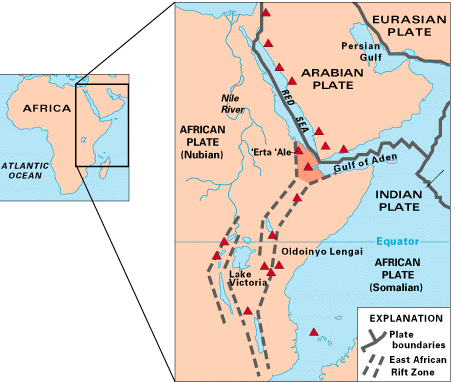
The Afar Triangle (also called the Afar Depression) is a geological depression caused by the Afar Triple Junction, which is part of the Great Rift Valley in East Africa. The region has disclosed fossil specimens of the very earliest hominins; that is, the earliest of the human clade, and it is thought by some paleontologists to be the cradle of the evolution of humans. The Depression overlaps the borders of Eritrea, Djibouti and the entire Afar Region of Ethiopia; and it contains the lowest point in Africa, Lake Assal, Djibouti, at 155 m (509 ft) below sea level.
Of note, Badwater Basin in the US is the lowest point, at just 282 feet below sea level.
Fascinating stuff.
|
"Monumental Diplomacy" - North Korea's role in world monuments and their ties to Namibia
I have not finished it yet as my commute is blessedly shorter than a single episode of the 99% Invisible, but I am finding this episode to be quite fascinating. I had no idea that North Korea is a major player in the world monument and architecture scene, especially in Africa. And it started before they became the hermetic nation of today (or, at least, in the earliest days of the nation's independence.) Also, the episode has been a good dip into the history of Namibia and how it relates to colonialism and South Africa's apartheid. I had no idea Namibia had once been a German colony in Africa.
Edit: Finished this episode this afternoon and it is excellent. It definitely starts hitting on some of the more interesting and politically angled directions North Korea's design team takes, as well as hammering on the slavish life these workers live while acknowledging the artists who create the monuments etc. are comparatively well taken care of. In addition they don't miss the chance to point out the existence of Mount Rushmore in our own bit of propogandist monuments.
|
"Japan to push for Africa seat on the UN Security Council"
"Japan reiterates its determination to redress the historical injustice against Africa of not being represented through a permanent membership on the Security Council," Prime Minister Fumio Kishida told the Tokyo International Conference on African Development in Tunis, Tunisia on Sunday.
|
"Tedros: Tigray, the Triple Billion, and a second term"
As Ukraine's coverage grew I recall seeing a few call outs that the media was hammering on Ukraine while there were a number of other countries undergoing invasions / wars / crises which got nowhere near as much coverage. This editorial highlights Dr. Tedros' calling attention to the Ethiopian crises and calls out the lack of western news coverage.
"Maybe the reason is the colour of the skin of the people in Tigray." Dr. Tedros confronted world leaders last week for their neglect of "the worst disaster on earth"—a storm of conflict in Ethiopia, extreme weather across the Horn of Africa, and soaring food, fuel, and fertiliser prices exacerbated by Russia's invasion of Ukraine. Tedros is not politically neutral, given his Tigrayan background and former high-level roles in the Ethiopian Government. But his suggestion that racism underpins the world's apparent indifference is worthy of consideration, by both the political and health communities.
|
"In Kenya, pending election results keep the nation in suspense"
I can certainly connect with the people of Kenya, the drawn out election process is a unique torture in this era of instant gratification.
It has been two days since voting ended in Kenya’s closely contested presidential election but for many citizens of the country, it feels like much longer.
“I am very anxious,” said Jacqueline Adhiambo, a 31-year-old resident of Eldoret, in western Kenya. “When I wake up in the middle of the night, I have to fight to desire to check my phone or turn on the television.”
Adhiambo, a voter registered in Eldoret, a stronghold of its most famous son, Deputy President and presidential candidate William Ruto, left her town for the capital, Nairobi, on the eve of the August 9 election. She was worried that violence could break out if Ruto lost to his closest competitor, Raila Odinga.
That line of thinking was critical to a 64 percent turnout in Tuesday’s election – a drop from almost 80 percent in 2017.
|
Redditor /u/Hoyarugby delivers great insights and context about American black men volunteering to go fight in Ethiopia and defend it from Mussolini
Reddit title for this photo: "African Americans in Harlem volunteering to go to Ethiopia and fight to save Africa’s last uncolonized nation from fascist Italian dictator Mussolini. Almost all volunteers were blocked from leaving by the US government. Few managed to go to Ethiopia. Summer 1935."

The top comment, which I linked, is super interesting and yet another example of a moment in American history I had no awareness of.
The war that is being discussed is The Second Italo-Ethiopian War which I did know about (only at the highest level of awareness, no real in depth knowledge) but I was completely unaware of this aspect of it from the US history perspective.
|
In Europe's move away from Russian gas, Africa is poised to be the big winner
This article highlights that African countries are using this leverage (rightly so) to demand a better bit of terms from global lenders to enable them to continue to build up their energy infrastructures if they are now going to be providing more to the European market.
As Europe scrambles for energy supplies, observers and Africans themselves are denouncing what they see as energy hypocrisy, considering that most African countries live under regular power shortages and are severely impacted by climate change. African governments have sought to develop new fossil fuel projects to meet local needs, but Western governments have demanded that multilateral lenders such as the World Bank stop funding those projects to reduce global carbon emissions.
“Our countries cannot achieve an energy transition and abandon the polluting patterns of the industrialized countries without a viable, fair, and equitable alternative,” Senegalese President Macky Sall said in a defiant speech at last year’s meeting of the U.N. General Assembly. “Stopping funding for the gas sector … would be a major obstacle.”
|
"Africa’s wildlife parks managers meet to boost conservation"
Officials are meeting in Kigali in Rwanda this week as part of the continent’s first-ever Africa Protected Areas Congress in a bid to expand the preservation of land and marine wildlife, despite little funding and the low quality of many existing conservation areas in the region.
[...]
The congress brings together wildlife parks and reserves managers, scientists, and Indigenous and community leaders. It’s hoped that increasing the dialogue between groups will improve the health of Africa’s biodiversity hotspots and combat worrying trends, such as the increase in poaching and the illegal wildlife trade.
|
An MP in the Ivory Coast has introduced a bill to legalize polygamy
Yacouba Sangaré, the MP who proposed the change, described the current matrimonial legislation in Ivory Coast as “a generalised hypocrisy”.
The elected member of the ruling The Rally of Houphouëtists for Democracy and Peace (RHDP) party filed a bill to amend a June 2019 law that stipulates that “no one may contract a new marriage before the first one is dissolved” and that sole state officials have the authority to legalise a union.
But the proposal has since sparked outrage among women’s rights organisations and feminist groups who have dubbed it a step back in the fight against gender inequality.
|
"African kings on medieval and Renaissance maps"
One of the questions that we consider in our current Gold exhibition is ‘where did the gold come from?’ In medieval Europe, natural deposits of gold were limited so most gold had to be either recycled by melting down older objects or imported by long-distance trade. From the 8th to 16th centuries, the kingdoms of West Africa were major suppliers and traders of gold, which was carried by camel caravans across the Sahara Desert to North Africa. From there, the gold travelled with merchants into the Middle East and Europe. Some of it ended up illuminating manuscripts thousands of miles away.
Medieval Europeans had little reliable information about West Africa, but they did know that it was an abundant source of gold. One account that made it all the way to medieval Europe was of the phenomenally wealthy Mansa Musa (r. 1312 to 1337), emperor of Mali, whose empire covered an area larger than Western Europe. In 1324 Mansa Musa made a pilgrimage to Mecca, bringing so much gold with him that it devalued the price of gold in Egypt, where he stopped on the way, for years afterwards. He is sometimes said to have been the richest person in history. In Europe, tales of this gold-drenched ruler made such an impression that he was portrayed on luxurious illustrated maps from the 14th to 16th centuries.
|
Explaining the Zulu click sounds
To quote a redditor, "this is an insane amount of linguistics condensed into 3 minutes"
|
What the Vai Script Reveals About the Evolution of Writing
Thanks to my friend Shivam for sharing this on Twitter!
This is very cool and gives an interesting look at the evolution of a natural writing system for an African language.
In a small West African village, a man named Momolu Duwalu Bukele had a compelling dream. A stranger approached him with a sacred book and then taught him how to write by tracing a stick on the ground. "Look!" said the spectral visitor. "These signs stand for sounds and meanings in your language."
Bukele, who had never learned to read or write, found that after waking he could no longer recall the precise signs the stranger revealed to him. Even so, he gathered the male members of his family together to reverse engineer the concept of writing. Working through the day and into the following night, the men devised a system of 200 symbols, each standing for a word or a syllable of their native Vai language. For millennia, varieties of the Vai language had been passed down from parents to children—but before this moment no speaker had ever recorded a single word in writing.
This took place in about 1833 in a region that would soon become the independent nation of Liberia. Vai, one of about 30 Indigenous languages of Liberia, has nearly 200,000 speakers today in the Cape Mount region that borders Sierra Leone.
|
A Kenyan Ecologist's Crusade to Save Her Country's Wildlife
Kenya has twenty-three national parks, but the habitat they offer is not enough to sustain the animals. In recent years, some of the indigenous communities that control much of the country's undeveloped land have made leasehold agreements with conservation groups and private safari companies. These arrangements have helped protect an estimated sixty-five per cent of Kenya's wildlife, while also aiding pastoralist groups like the Maasai. But they are precarious—a patchwork of thousands of contracts, each one subject to renegotiation whenever a local leader raises his rate or a nonprofit loses funding. Where they fail, the wilderness habitat will disappear, and the animals will, too.
This excerpt is reason enough to read it. The article follows Kahumbu and discusses her life, along with the context of Kenya's fight for animal and land conservation.
Kahumbu, inspired, resolved to be a veterinarian when she grew up. But her father left the family when she was in her teens, and her mother, struggling to make ends meet, made her promise to go to secretarial school instead.
When she was sixteen, Kahumbu won a place in an expedition organized by a British academic organization. "They invited sixty kids to apply and put all of us on a hill for two days to see how we fared, and ten of us were selected," she said. The winners spent a month trekking through the remote north of Kenya, led by a Samburu man who had guided the legendary British explorer Wilfred Thesiger. "We were a bunch of kids on their own, climbing rain-forested mountains and walking across desert, and we covered over six hundred miles on foot," Kahumbu said. She was assigned to collect earwigs, wood lice, and scorpions. "I totally loved it," she said, laughing. "But at times it was very dangerous. Lions followed us. We almost got washed out by a flash flood, and, once, we ran out of water. It was high adventure, and I realized that I could never be a secretary."
This isn't a story about the need for other countries to rescue Africa, and in many ways I think it is about the opposite of that. Kenya is growing as a country, as of 2019 it is 9th in Africa ranked by GDP, and 7th by population. There is a need for a growing country to use its natural resources and that is something at odds with the need for protecting of wildlife, it's the classic struggle we see like when a Republican President signs off on an oil pipeline which destroys lands, or fracking, etc. Doing these things brings jobs, and it brings resources for companies.
Should Kenya do it? No, I'm not saying that. I am far from smart enough to say that. But I am saying that as countries grow economically, the stress and pressure on it is high.
Now, the article highlights that the youth of Kenya seem to be aligned in the need to protect these lands, but it only takes indirect mistakes to enable politicians to make these choices. And in fact, it highlights critics of hunting tourism (predominately white) and how it reveals the fake and wrong belief that Kenyans (and Africans at large) do care about their natural resources, be it land, creature or plant.
While Kahumbu is trying to mend the racial divide, others are more confrontational. The carnivore ecologist Mordecai Ogada has drawn attention by campaigning against what he calls "white colonialist" control of wildlife tourism and conservation. Ogada is a compelling speaker and a forceful presence on social media; in 2016, he co-authored a book, "The Big Conservation Lie: The Untold Story of Wildlife Conservation in Kenya," with John Mbaria, a Kenyan journalist. On the cover, a beefy white man enjoys a cigar and a glass of brandy, while a native woman stoops over in labor; antelopes graze in the distance. "Coarsely speaking, the current white paradigm is that African wildlife is in danger, and the problem is that African people don't love the animals like white people do," Ogada explained in an interview promoting the book. "I would like to see a model where Black people are treated as the true custodians of the wildlife with which they share their lands and are intellectual participants in the discourse around this wildlife. That would be the Black paradigm, one in which white people are most welcome to participate." In December, I asked Ogada what changes could be made to involve more Black Africans in conservation. "Your question betrays the problem," he replied. "Why do you think we weren't involved in conservation before, and how do you think wildlife survived before the white saviors came?"
|
