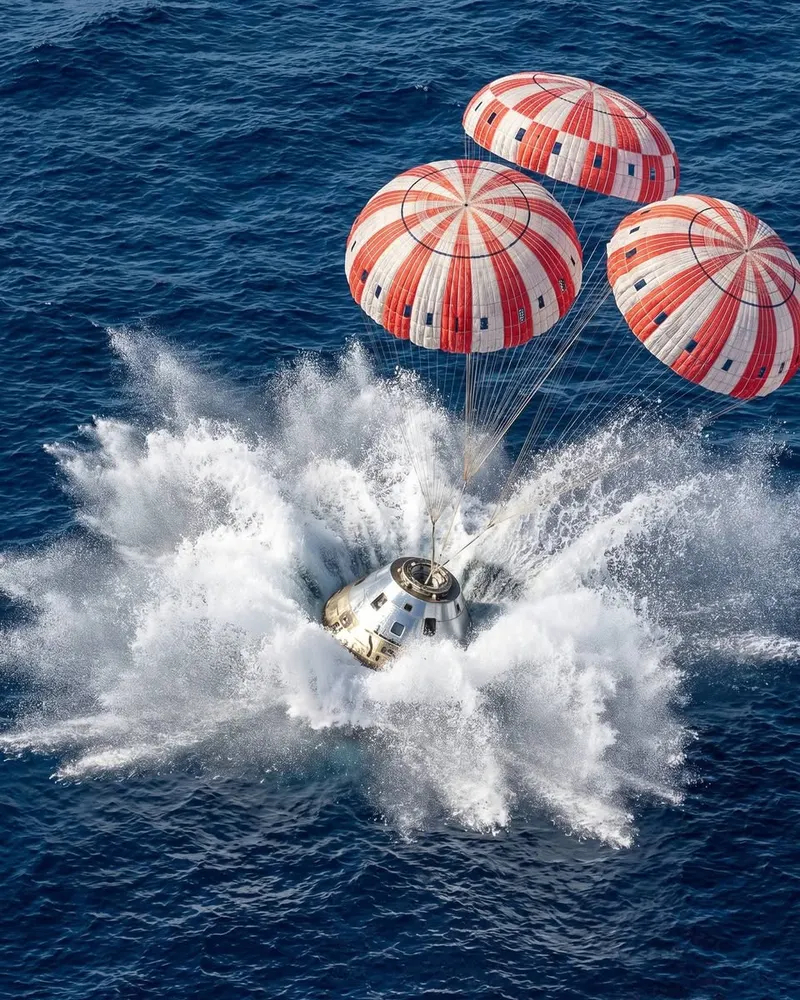
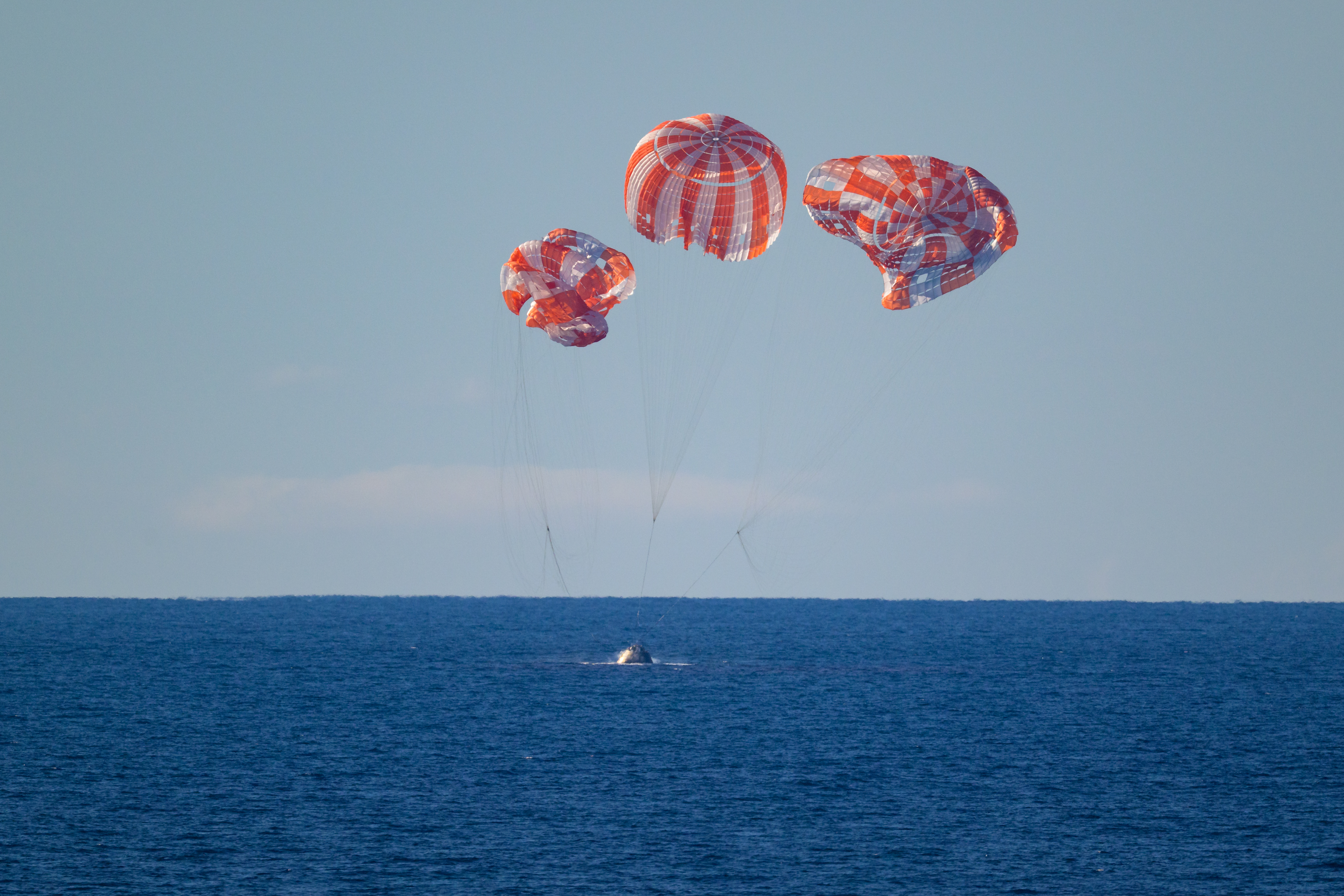
Splashdown
I have missed being excited for regular manned space missions. Thank you to Artemis II mission and its crew for reminding me the joy and awe that these can bring.
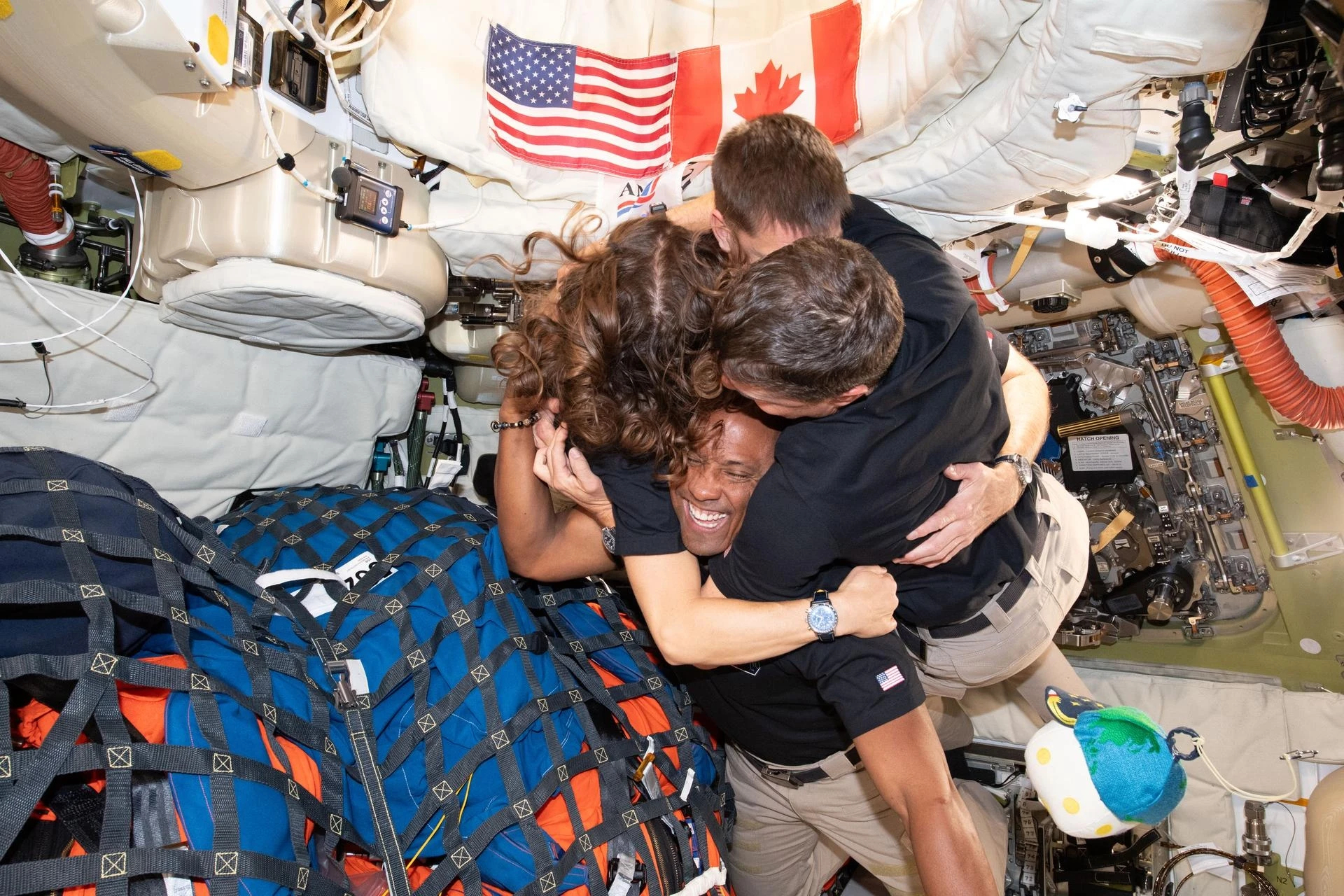
My favorite photo from this mission:

 |
|
Artemis II is heading for the moon

"We've got a beautiful moonrise and we're headed right at it." -Wiseman
Hearing them say that punched me in the gut. I grew up in Florida seeing shuttle and rocket launches and we haven't been to the moon in my lifetime.
|
"NASA Shuts Off Voyager Science Instrument, More Power Cuts Ahead to Keep Both Probes Going"
Incredible engineering that two probes, launched 50 years ago, are still going and that we're able to control them from this distance to shut off systems and prolong their lives. Truly a marvel.
|
 Fly Me To The Moon (2024) - 3 of 5 Atlas Rockets
I heard the hook of this movie and put off watching it, but I'm glad I did. It was cute and well done. Reminded me of a mixture of The Right Stuff and Wag The Dog.
|

"The Ambiguity of Exoplanet Biosignatures"
The search for life on planets beyond our Solar System is too often depicted as a binary process. One day, so the thinking goes, we'll be able to directly image an Earth-mass exoplanet whose atmosphere we can then analyze for biosignatures. Then we'll know if there is life there or not. If only the situation were that simple! As Alex Tolley explains in his latest essay, we're far more likely to run into results that are so ambiguous that the question of life will take decades to resolve. Read on as Alex delves into the intricacies of life detection in the absence of instruments on a planetary surface.
|
NOAA Space Weather Prediction Center issued a Severe (G4) Geomagnetic Storm Watch

Listened to Carl Sagan's "Pale blue dot" while looking up at the night sky. The colors weren't as vivid as the photo shows, but it was still a magical moment to know we were seeing a special life event.
Another excellent segment from Sagan, titled 'Humility'
|
So, given the eclipse, I've seen it brought up again how we are, as far as we know, the only planet in the galaxy which experiences total solar eclipses. It's an astronomical anomaly that our moon perfectly covers the sun.
I have zero proof, but I have been wondering if this isn't simply coincidence, but is instead one of the multitude of variables which was needed to enable our life to exist. Not only does a planet need to be in the Goldilocks zone with water available, but it also needs a moon of proper size to drive the tides similar to ours.
Probably not, but I can't shake the thought.
|
How rare is the total eclipse from 2024?
I don't think this is the originator of this video, but I haven't found the true source yet. I found this breakdown of the eclipse frequency fascinating.
|
Fascinating astronomy thread about "Zoozve" aka Venus' quasi-moon
Great story about how one dad got curious about something on his kid's astronomy poster and came to learn something new about space.
|
Mars Ingenuity helicopter flew almost half a mile during one flight in December
The mission on Mars still going is amazing. What an incredible feat of engineering.
NASA's Ingenuity helicopter set a new Mars record last month, by the skin of its robotic teeth.
The 4-pound (1.8 kilograms) Ingenuity covered 2,315 feet (705 meters) of Red Planet ground on Dec. 20, according to the mission's flight log. The old mark was 2,310 feet (704 m), which the little chopper set in April 2022.
Ingenuity reached 22.4 mph (36 kph) during the Dec. 20 hop, tying its Martian speed record.
|
Chandrayaan-3 spacecraft lands successfully on the moon
Congratulations India, what a huge moment. An exciting event for the future of space exploration.
|
India and Russia's very different (so far) moon missions
Russia's Luna-25 crashed into the moon last night.
Russia's unmanned Luna-25 spacecraft has crashed into the Moon after spinning out of control, officials say.
It was Russia's first Moon mission in almost 50 years.
The craft was due to be the first ever to land on the Moon's south pole, but failed after encountering problems as it moved into its pre-landing orbit.
Meanwhile, India's Chandrayaan-3 completed it's final lunar orbit.
Vikram, which carries a rover in its belly, is due to land near the south pole on 23 August.
The lander detached from the propulsion module, which carried it close to the Moon, on Thursday.
The black-and-white images show close-ups of rocks and craters on the Moon's surface. One of the photographs shows the propulsion module too.
If successful, India will be the fourth country to achieve a moon landing with USA, USSR and China.
|
"The ancient technology keeping space missions alive"
Designed to fly in formation to investigate the interaction between charged particles from the Sun – the solar wind – and the magnetic bubble surrounding the Earth, known as the magnetosphere, Cluster II ranks as one of the most successful and long-lasting science missions ever flown. The satellites (named Rumba, Salsa, Samba and Tango, since you ask) have just celebrated 23 years in orbit.
I just love the name of the four satellites. But the article is a great read overall, highly recommend.
|
Akin's Laws of Spacecraft Design
- Engineering is done with numbers. Analysis without numbers is only an opinion.
- To design a spacecraft right takes an infinite amount of effort. This is why it's a good idea to design them to operate when some things are wrong .
- Design is an iterative process. The necessary number of iterations is one more than the number you have currently done. This is true at any point in time.
- Your best design efforts will inevitably wind up being useless in the final design. Learn to live with the disappointment.
- (Miller's Law) Three points determine a curve.
- (Mar's Law) Everything is linear if plotted log-log with a fat magic marker.
- At the start of any design effort, the person who most wants to be team leader is least likely to be capable of it.
- In nature, the optimum is almost always in the middle somewhere. Distrust assertions that the optimum is at an extreme point.
- Not having all the information you need is never a satisfactory excuse for not starting the analysis.
- When in doubt, estimate. In an emergency, guess. But be sure to go back and clean up the mess when the real numbers come along.
- Sometimes, the fastest way to get to the end is to throw everything out and start over.
- There is never a single right solution. There are always multiple wrong ones, though.
- Design is based on requirements. There's no justification for designing something one bit "better" than the requirements dictate.
- (Edison's Law) "Better" is the enemy of "good".
- (Shea's Law) The ability to improve a design occurs primarily at the interfaces. This is also the prime location for screwing it up.
- The previous people who did a similar analysis did not have a direct pipeline to the wisdom of the ages. There is therefore no reason to believe their analysis over yours. There is especially no reason to present their analysis as yours.
- The fact that an analysis appears in print has no relationship to the likelihood of its being correct.
- Past experience is excellent for providing a reality check. Too much reality can doom an otherwise worthwhile design, though.
- The odds are greatly against you being immensely smarter than everyone else in the field. If your analysis says your terminal velocity is twice the speed of light, you may have invented warp drive, but the chances are a lot better that you've screwed up.
- A bad design with a good presentation is doomed eventually. A good design with a bad presentation is doomed immediately.
- (Larrabee's Law) Half of everything you hear in a classroom is crap. Education is figuring out which half is which.
- When in doubt, document. (Documentation requirements will reach a maximum shortly after the termination of a program.)
- The schedule you develop will seem like a complete work of fiction up until the time your customer fires you for not meeting it.
- It's called a "Work Breakdown Structure" because the Work remaining will grow until you have a Breakdown, unless you enforce some Structure on it.
- (Bowden's Law) Following a testing failure, it's always possible to refine the analysis to show that you really had negative margins all along.
- (Montemerlo's Law) Don't do nuthin' dumb.
- (Varsi's Law) Schedules only move in one direction.
- (Ranger's Law) There ain't no such thing as a free launch.
- (von Tiesenhausen's Law of Program Management) To get an accurate estimate of final program requirements, multiply the initial time estimates by pi, and slide the decimal point on the cost estimates one place to the right.
- (von Tiesenhausen's Law of Engineering Design) If you want to have a maximum effect on the design of a new engineering system, learn to draw. Engineers always wind up designing the vehicle to look like the initial artist's concept.
- (Mo's Law of Evolutionary Development) You can't get to the moon by climbing successively taller trees.
- (Atkin's Law of Demonstrations) When the hardware is working perfectly, the really important visitors don't show up.
- (Patton's Law of Program Planning) A good plan violently executed now is better than a perfect plan next week.
- (Roosevelt's Law of Task Planning) Do what you can, where you are, with what you have.
- (de Saint-Exupery's Law of Design) A designer knows that they have achieved perfection not when there is nothing left to add, but when there is nothing left to take away.
- Any run-of-the-mill engineer can design something which is elegant. A good engineer designs systems to be efficient. A great engineer designs them to be effective.
- (Henshaw's Law) One key to success in a mission is establishing clear lines of blame.
- Capabilities drive requirements, regardless of what the systems engineering textbooks say.
- Any exploration program which "just happens" to include a new launch vehicle is, de facto, a launch vehicle program.
- (McBryan's Law) You can't make it better until you make it work.
- There's never enough time to do it right, but somehow, there's always enough time to do it over.
- If there's not a flight program, there's no money. If there is a flight program, there's no time.
- You really understand something the third time you see it (or the first time you teach it.)
- (Lachance's Law) "Plenty of time" becomes "not enough time" in a very short time.
- Space is a completely unforgiving environment. If you screw up the engineering, somebody dies (and there's no partial credit because most of the analysis was right...)
|
Indian Space Mission Enters Moon's Orbit
A fantastic accomplishment, especially when you consider the cost for the mission was less than $75 million!
Experts say India can keep costs low by copying and adapting existing space technology, and thanks to an abundance of highly skilled engineers who earn a fraction of their foreign counterparts’ wages.
The Chandrayaan-3 spacecraft has taken much longer to reach the moon than the manned Apollo missions of the 1960s and 1970s, which arrived in a matter of days.
The Indian rocket used is much less powerful than the United States’ Saturn V and instead the probe orbited Earth five or six times elliptically to gain speed, before being sent on a month-long lunar trajectory.
If the landing is successful the rover will roll off Vikram and explore the nearby lunar area, gathering images to be sent back to Earth for analysis.
The rover has a mission life of one lunar day or 14 Earth days.
|
"Upcoming Planetary Events and Missions"
Managed by NASA official, Dr. David R. Williams. It's an official list of space missions and events, not just by NASA but by other space organizations. Here's the rest of the year:
- 2023 July 14 - Chandrayaan 3 - Launch of ISRO (India) Lunar Orbiter, Lander, and Rover to the Moon
- 2023 August - Luna 25 - Launch of Russian lunar lander
- 2023 August 21 - Parker Solar Probe - NASA solar mission makes sixth Venus flyby
- 2023 September 24 - OSIRIS-Rex - Returns to Earth with sample of asteroid Bennu
- 2023 October 5 - Psyche - Launch of orbiter mission to main belt asteroid 16 Psyche
- 2023 November 1 - Lucy - NASA mission flies by asteroid 1999 VD57
- 2023 November - Intuitive Machines 2 (PRIME-1) - Launch of NASA CLPS lunar rover
- 2023 November - Lunar Trailblazer - Launch of NASA SmallSat mission to study lunar water
- 2023 - Peregrine Mission 1 (TO 2-AB) - Launch of NASA CLPS lunar lander
- 2023 - Smart Lander for Investigating Moon (SLIM) - Launch of JAXA lunar lander mission
- TBD - Intuitive Machines 1 (TO 2-IM) - Launch of NASA CLPS lunar lander
And this is the last entry on the list:
4,000,000 - Pioneer 11 - NASA flyby of star Lambda Aquila
That last link is a link to a memo from 1995 discussing the end of the Pioneer 11 mission.
After nearly 22 years of exploration out to the farthest reaches of the Solar System, one of the most durable and productive space missions in history will come to a close.
Now beyond the orbit of Pluto and more than four billion miles from Earth, NASA's unmanned Pioneer 11 spacecraft is heading out into interstellar space. Because the spacecraft's power is too low to operate its instruments and transmit data, on September 30 NASA will cease daily communications with the spacecraft. At that distance, faint signals from Pioneer 11 traveling at the speed of light take over six hours to reach Earth.
The spacecraft will continue speeding out into interstellar space toward the center of the Milky Way, taking an engraved gold plaque bearing a message about Earth to other civilizations which it may encounter. Pioneer 11 will pass near the star Lambda Aquila in almost four million years.
...
|
Apollo Remastered
Found via kottke.org. This book and the photos look truly stunning. I did a double-take on seeing the below photo on Jason's blog.
NASA keeps the original film negatives from the Apollo program sealed in a frozen vault in Houston, TX and rarely grants access to them. As a result, nearly all of the photos we see of those historic missions were made decades ago or are copies of copies. Recently, the film was cleaned and digitally scanned at "an unprecedented resolution".
Using these new high-res scans, image specialist Andy Saunders remastered each of the 35,000 photographs, resulting in this incredible-looking book, Apollo Remastered: The Ultimate Photographic Record. From the book's website:
The photographs from the lunar surface are as close as we can get to standing on the Moon ourselves, and for the first time, we were able to look back at Earth from afar, experiencing the "overview effect" — the cognitive shift that elicits an intense emotional experience upon seeing our home planet from space for the first time. The "Blue Marble" photograph, taken as Apollo 17 set course for the Moon, depicts the whole sunlit Earth, and is the most reproduced photograph of all time. Along with Apollo 8's "Earthrise," which depicts Earth above the lunar horizon, it was a catalyst for the environmental movement that continues today.

|
