Nature Wants Diversity
I went to bed earlier than I meant to last night. Around 6pm I was dozing off on the couch so I told Katie I would go lay down for a bit. Next thing I know it's 12:30am and I wake up. Oops.
I eventually got back to bed and slept until the dogs woke me up.
But as I was trying to fall asleep I had a thought and made a note to myself. I realized that the different human traits we perceive are the evolutionary tips of these traits, and that they represent genetics doing what we call evolution. More than that though, I realized this is also true of traits which are spectrums, not solely ones where we have different colors for example.
Nature wants diversity, it's healthy for there to be a range of something as it helps ensure survival of a species rather than relying on a monolithic genetic model that is at risk of a single critical flaw.
This isn't a new realization for the humanity, but I had never consciously recognized it in this explicit a perspective.

 |
|
Artemis II is heading for the moon

"We've got a beautiful moonrise and we're headed right at it." -Wiseman
Hearing them say that punched me in the gut. I grew up in Florida seeing shuttle and rocket launches and we haven't been to the moon in my lifetime.
|

"NASA Shuts Off Voyager Science Instrument, More Power Cuts Ahead to Keep Both Probes Going"
Incredible engineering that two probes, launched 50 years ago, are still going and that we're able to control them from this distance to shut off systems and prolong their lives. Truly a marvel.
|
"‘A neural fossil’: human ears try to move when listening, scientists say"
Wiggling your ears might be more of a pub party piece than a survival skill, but humans still try to prick up their ears when listening hard, researchers have found.
Ear movement is crucial in many animals, not least in helping them focus their attention on particular noises and work out which direction they are coming from.
But while the human ear is far more static, traces of our ancestors' ear-orienting system remain in what has been called a "neural fossil".
"It is believed that our ancestors lost their ability to move their ears about 25m years ago. Why, exactly, is difficult to say," said Andreas Schröer, the lead author of the research from Saarland University in Germany.
"However, we have been able to demonstrate that the neural circuits still seem to be present in some state, [that is] our brain retained some of the structures to move the ears, even though they apparently are not useful any more."
|
The rarest mineral has only ever been found once

It's called kyawthuite (cha-too-ite), a tiny, tawny-hued grain weighing just a third of a gram (1.61 carats). On first glance, you might mistaken it for amber or topaz; but the unassuming mineral speck has value beyond measure.
The stone itself was purchased in 2010 at a market in Chaung-gyi in Myanmar by gemologist Kyaw Thu, who thought the raw gem was a mineral called scheelite. After he faceted the stone, though, he realized that he was looking at something unusual.
|
"Like ‘old Twitter’: The scientific community finds a new home on Bluesky"
In July 2023, Adam Kucharski asked his Twitter followers: What platform do you think you will be spending the most time on a year from now? Like many scientists on Twitter, Kucharski, a mathematical modeler of infectious diseases, was increasingly frustrated with changes to the platform since Elon Musk bought it in October 2022. But of the more than 1300 people who responded to his poll, the vast majority expected to keep posting on Twitter, which was renamed X just 2 weeks later. About one-quarter were banking on Threads, Meta's Twitter rival. Only about 7% chose Bluesky.
Now, that has changed, in a big way. Although academics mostly stuck with X in the year after the poll, Bluesky has rapidly emerged as the new online gathering place for researchers, Kucharski among them. They are drawn by its Twitter-like feel, welcoming features, and, increasingly, the critical mass of scientists in many fields who have already made the move. "The majority has spoken, and researchers are moving en masse" to Bluesky, says De-Shaine Murray, a neuroscientist at Yale University who has also migrated to Bluesky.
"It's just gone completely crazy," says Mike Young, a science communicator in Denmark who gives social media workshops to scientists. He and his colleague Lasse Hjorth Madsen did an analysis in August mapping science communities on Bluesky. They found more than 20,000 influential scientists—people on the platform who were followed by at least 30 other scientists in the same network. When they repeated the analysis last week with an increased threshold of 40 scientist followers, the new number of influential scientists was almost 40,000. It is likely to be many times that now, Young says.
|
Partnership for Public Service
Brought to my attention via this opinion article on the Washington Post which highlights the effort this organization is putting into bringing recognition to individuals who excel as public servants.
The organization, called the Partnership for Public Service, created the awards, called the Sammies, in 2002 to call out extraordinary deeds inside the federal government. Founded the year before by an entrepreneur named Samuel Heyman, it set out to attract talented and unusual people to the federal workforce. One big reason talented and unusual people did not gravitate to the government was that the government was often a miserable place for talented and unusual people to work. Civil servants who screwed up were dragged before Congress and into the news. Civil servants who did something great, no one said a word about. There was thus little incentive to do something great, and a lot of incentive to hide. The awards were meant to correct that problem. "There's no culture of recognition in government," said Max Stier, whom Heyman hired to run the Partnership. "We wanted to create a culture of recognition."
A third was given to a man inside the Energy Department who had been sent to a massive nuclear waste dump outside Denver, containing enough radioactive gunk to fill 90 miles of railroad cars, and told to clean it up. He finished the project $30 billion under budget and 60 years ahead of schedule — and turned the dump into a park.
That man was Frazer Lockhart in 2007. From the linked page about his award:
The federal government created the Superfund program in 1980 to clean up the country's most dangerous abandoned toxic waste sites. Out of the hundreds of environmental hazards on the Superfund list, the Rocky Flats plant outside of Denver, Colorado was among the worst of the worst. Rocky Flats was a nuclear weapons production facility that manufactured plutonium triggers for nuclear warheads for nearly 40 years. In 1989, it was shut down after a raid by the FBI and EPA discovered multiple pollution violations. Some people suggested that Rocky Flats should be a "sacrifice site," meaning cleanup was impossible and should not even be attempted. As recently as 1995, a cleanup effort was estimated to cost $37 billion and take 70 years to complete. Frazer Lockhart and his team at the Department of Energy managed to prove the skeptics wrong. Working with contractors, local officials and his federal colleagues, Lockhart led the effort to successfully remediate Rocky Flats in just 10 years, at a cost of $7 billion.
If the fact that the project was completed decades ahead of schedule and billions of dollars under budget were not astounding enough, consider the following. According to the Department of Energy, the cleanup team removed more than 21 tons of weapons-usable nuclear materials; decontaminated and demolished 800 structures, comprising more than 3 million square feet; drained 30,000 liters of plutonium solution; stabilized and packaged 100 tons of high-content plutonium residue; performed environmental cleanup actions at 130 sites; dispositioned millions of classified items and excess property; and safely shipped more than 600,000 cubic meters of radioactive waste to a safe disposal site — enough to fill a string of railcars 90 miles long.
The project was the largest and most successful cleanup ever conducted by the Department of Energy, and Lockhart recently received EPA approval for over 95% of the formerly restricted land to be officially removed from the Superfund list. The majority of the 6,200-acre site is scheduled to be transferred to the Department of the Interior and will become a national wildlife refuge.
I'm excited to learn about the Partnership for Public Service and follow as more people get recognized and help shine a light on the good work being done in the government.
|
"The Ambiguity of Exoplanet Biosignatures"
The search for life on planets beyond our Solar System is too often depicted as a binary process. One day, so the thinking goes, we'll be able to directly image an Earth-mass exoplanet whose atmosphere we can then analyze for biosignatures. Then we'll know if there is life there or not. If only the situation were that simple! As Alex Tolley explains in his latest essay, we're far more likely to run into results that are so ambiguous that the question of life will take decades to resolve. Read on as Alex delves into the intricacies of life detection in the absence of instruments on a planetary surface.
|
NOAA Space Weather Prediction Center issued a Severe (G4) Geomagnetic Storm Watch

Listened to Carl Sagan's "Pale blue dot" while looking up at the night sky. The colors weren't as vivid as the photo shows, but it was still a magical moment to know we were seeing a special life event.
Another excellent segment from Sagan, titled 'Humility'
|
So, given the eclipse, I've seen it brought up again how we are, as far as we know, the only planet in the galaxy which experiences total solar eclipses. It's an astronomical anomaly that our moon perfectly covers the sun.
I have zero proof, but I have been wondering if this isn't simply coincidence, but is instead one of the multitude of variables which was needed to enable our life to exist. Not only does a planet need to be in the Goldilocks zone with water available, but it also needs a moon of proper size to drive the tides similar to ours.
Probably not, but I can't shake the thought.
|
How rare is the total eclipse from 2024?
I don't think this is the originator of this video, but I haven't found the true source yet. I found this breakdown of the eclipse frequency fascinating.
|
Reddit: what's the scariest science fact that the public knows nothing about?
Scientists were trying to study the effects that microplastics have on the human body and brain but were unable to draw any reasonable conclusions because they could not find a control group.
Not exactly surprising.
In response to the above.
Something similar happened when they tried testing for lead back in the day. The ultra clean labs we have today were originally designed so for this reason. Also, the investigation into lead also led to the discovery of the age of the Earth
I have not researched these claims yet. They are easy enough for me to believe, but I'll be curious for supporting research.
|
TIL how the Meter was originally defined
From the Wikipedia entry:
The metre was originally defined in 1791 as one ten-millionth of the distance from the equator to the North Pole along a great circle, so the Earth's circumference is approximately 40000 km. In 1799, the metre was redefined in terms of a prototype metre bar. The actual bar used was changed in 1889. In 1960, the metre was redefined in terms of a certain number of wavelengths of a certain emission line of krypton-86.
I had no idea it was defined based off the size of the planet. Love it.
|
Chandrayaan-3 spacecraft lands successfully on the moon
Congratulations India, what a huge moment. An exciting event for the future of space exploration.
|
FLIP Maritime research vessel set to retire after 60 years
The ship which rotates and sinks the majority of its length is retiring after 60 years.
|
"The ancient technology keeping space missions alive"
Designed to fly in formation to investigate the interaction between charged particles from the Sun – the solar wind – and the magnetic bubble surrounding the Earth, known as the magnetosphere, Cluster II ranks as one of the most successful and long-lasting science missions ever flown. The satellites (named Rumba, Salsa, Samba and Tango, since you ask) have just celebrated 23 years in orbit.
I just love the name of the four satellites. But the article is a great read overall, highly recommend.
|
 Contact (1997) - 5/5 Stars
The universe is a pretty big place. If it's just us, seems like an awful waste of space.
I love this movie. It's truly fantastic and nails the hopeful dream of science, and the headwinds it faces at every step of the way. I apparently hadn't spoken of my love of this movie to Katie before, but I would consider this movie among my top 10 science fiction films of all time, possibly higher.
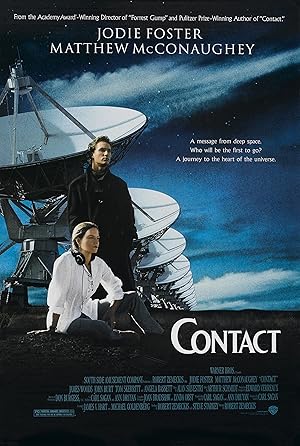
Of course the movie is based on the book written by Carl Sagan. Sagan didn't live long enough to see the movie, but he worked on the film and reportedly did his best to keep it heavily based in science.
|

"Upcoming Planetary Events and Missions"
Managed by NASA official, Dr. David R. Williams. It's an official list of space missions and events, not just by NASA but by other space organizations. Here's the rest of the year:
- 2023 July 14 - Chandrayaan 3 - Launch of ISRO (India) Lunar Orbiter, Lander, and Rover to the Moon
- 2023 August - Luna 25 - Launch of Russian lunar lander
- 2023 August 21 - Parker Solar Probe - NASA solar mission makes sixth Venus flyby
- 2023 September 24 - OSIRIS-Rex - Returns to Earth with sample of asteroid Bennu
- 2023 October 5 - Psyche - Launch of orbiter mission to main belt asteroid 16 Psyche
- 2023 November 1 - Lucy - NASA mission flies by asteroid 1999 VD57
- 2023 November - Intuitive Machines 2 (PRIME-1) - Launch of NASA CLPS lunar rover
- 2023 November - Lunar Trailblazer - Launch of NASA SmallSat mission to study lunar water
- 2023 - Peregrine Mission 1 (TO 2-AB) - Launch of NASA CLPS lunar lander
- 2023 - Smart Lander for Investigating Moon (SLIM) - Launch of JAXA lunar lander mission
- TBD - Intuitive Machines 1 (TO 2-IM) - Launch of NASA CLPS lunar lander
And this is the last entry on the list:
4,000,000 - Pioneer 11 - NASA flyby of star Lambda Aquila
That last link is a link to a memo from 1995 discussing the end of the Pioneer 11 mission.
After nearly 22 years of exploration out to the farthest reaches of the Solar System, one of the most durable and productive space missions in history will come to a close.
Now beyond the orbit of Pluto and more than four billion miles from Earth, NASA's unmanned Pioneer 11 spacecraft is heading out into interstellar space. Because the spacecraft's power is too low to operate its instruments and transmit data, on September 30 NASA will cease daily communications with the spacecraft. At that distance, faint signals from Pioneer 11 traveling at the speed of light take over six hours to reach Earth.
The spacecraft will continue speeding out into interstellar space toward the center of the Milky Way, taking an engraved gold plaque bearing a message about Earth to other civilizations which it may encounter. Pioneer 11 will pass near the star Lambda Aquila in almost four million years.
...
|
