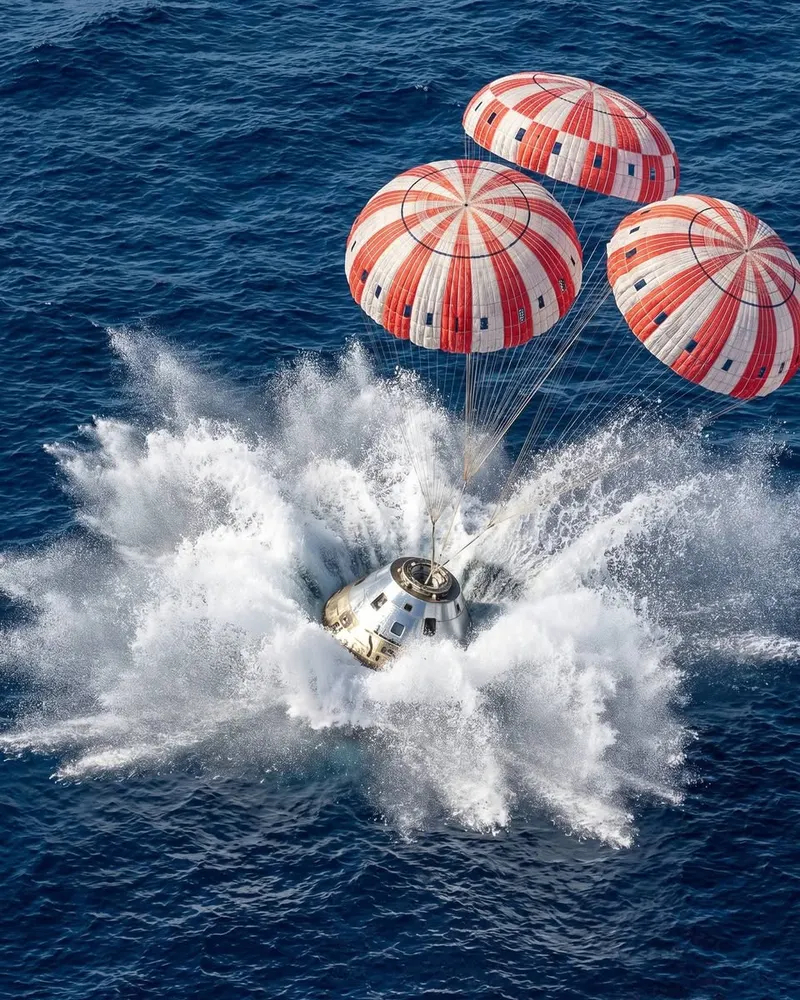
Splashdown
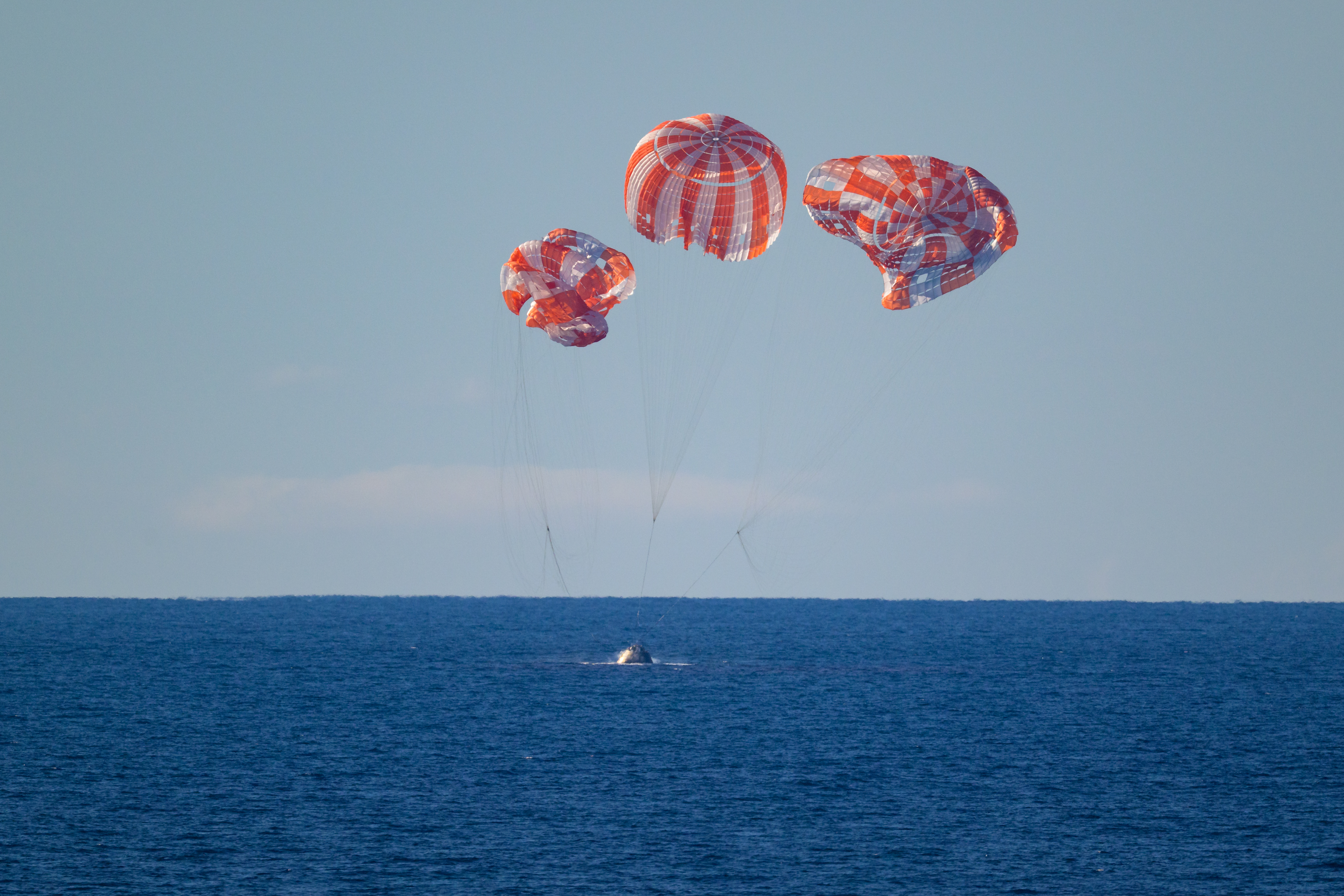
I have missed being excited for regular manned space missions. Thank you to Artemis II mission and its crew for reminding me the joy and awe that these can bring.
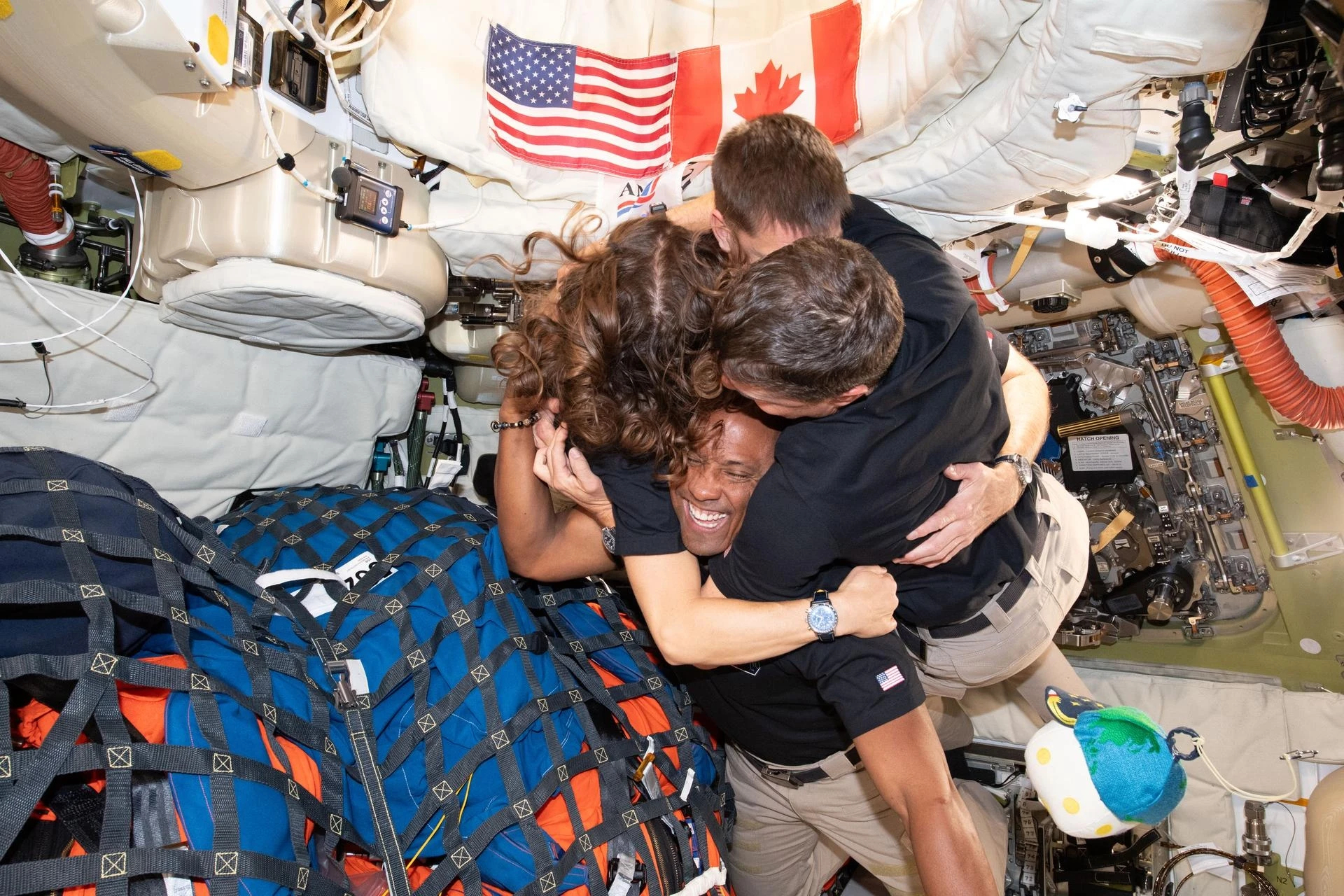
My favorite photo from this mission:

 |
|
Artemis II is heading for the moon

"We've got a beautiful moonrise and we're headed right at it." -Wiseman
Hearing them say that punched me in the gut. I grew up in Florida seeing shuttle and rocket launches and we haven't been to the moon in my lifetime.
|
"NASA Shuts Off Voyager Science Instrument, More Power Cuts Ahead to Keep Both Probes Going"
Incredible engineering that two probes, launched 50 years ago, are still going and that we're able to control them from this distance to shut off systems and prolong their lives. Truly a marvel.
|
 Fly Me To The Moon (2024) - 3 of 5 Atlas Rockets
I heard the hook of this movie and put off watching it, but I'm glad I did. It was cute and well done. Reminded me of a mixture of The Right Stuff and Wag The Dog.
|
Mars Ingenuity helicopter flew almost half a mile during one flight in December
The mission on Mars still going is amazing. What an incredible feat of engineering.
NASA's Ingenuity helicopter set a new Mars record last month, by the skin of its robotic teeth.
The 4-pound (1.8 kilograms) Ingenuity covered 2,315 feet (705 meters) of Red Planet ground on Dec. 20, according to the mission's flight log. The old mark was 2,310 feet (704 m), which the little chopper set in April 2022.
Ingenuity reached 22.4 mph (36 kph) during the Dec. 20 hop, tying its Martian speed record.
|
Incredible photo titled "Cathedral, Mountain, Moon"

From the NASA webpage:
Single shots like this require planning. The first step is to realize that such an amazing triple-alignment actually takes place. The second step is to find the best location to photograph it. But it was the third step: being there at exactly the right time -- and when the sky was clear -- that was the hardest. Five times over six years the photographer tried and found bad weather. Finally, just ten days ago, the weather was perfect, and a photographic dream was realized. Taken in Piemonte, Italy, the cathedral in the foreground is the Basilica of Superga, the mountain in the middle is Monviso, and, well, you know which moon is in the background. Here, even though the setting Moon was captured in a crescent phase, the exposure was long enough for doubly reflected Earthlight, called the da Vinci glow, to illuminate the entire top of the Moon.
|
A look at Huntsville's Space legacy and discussing the impact of Space Command remaining in Colorado
Alabama Senator Tuberville could be to blame for his idiotic fight against abortion rights in the military. Single handedly blocking promotions and titles in the Pentagon, leads many believe this decision for Space Command's location to not move to Alabama are political blowback.
But this week the Pentagon announced it had reversed that call, instead keeping the headquarters in Colorado Springs. The decision left many in Huntsville smarting at being cast into the outer orbit of influence and questioning whether their city was passed over for political reasons beyond their control.
The article goes on to highlight that this isn't explicitly political blowback on Tuberville, but many think it is:
Pentagon officials said keeping the headquarters in Colorado, where it has been temporarily located on a Space Force base shared with NORAD command, was a matter of maintaining military readiness and avoiding a potentially lengthy and costly move.
But some political observers saw the choice of a Democratic-controlled state both as a rejection of the hard-line conservatism in Alabama and a repudiation of its senior Republican senator, Tommy Tuberville, who has blocked hundreds of military promotions over a Pentagon policy that reimburses military personnel who travel to obtain an abortion or fertility care
I have friends in Huntsville and it's the only city in the state that I'd agree to visiting. It's role in the Space industry was fascinating to me since it wasn't Florida, or Texas, or California. It always felt weird to me. But that's how politics go. Someone pulls a favor or makes a deal and suddenly you've got a government industry in your state.
|
"Upcoming Planetary Events and Missions"
Managed by NASA official, Dr. David R. Williams. It's an official list of space missions and events, not just by NASA but by other space organizations. Here's the rest of the year:
- 2023 July 14 - Chandrayaan 3 - Launch of ISRO (India) Lunar Orbiter, Lander, and Rover to the Moon
- 2023 August - Luna 25 - Launch of Russian lunar lander
- 2023 August 21 - Parker Solar Probe - NASA solar mission makes sixth Venus flyby
- 2023 September 24 - OSIRIS-Rex - Returns to Earth with sample of asteroid Bennu
- 2023 October 5 - Psyche - Launch of orbiter mission to main belt asteroid 16 Psyche
- 2023 November 1 - Lucy - NASA mission flies by asteroid 1999 VD57
- 2023 November - Intuitive Machines 2 (PRIME-1) - Launch of NASA CLPS lunar rover
- 2023 November - Lunar Trailblazer - Launch of NASA SmallSat mission to study lunar water
- 2023 - Peregrine Mission 1 (TO 2-AB) - Launch of NASA CLPS lunar lander
- 2023 - Smart Lander for Investigating Moon (SLIM) - Launch of JAXA lunar lander mission
- TBD - Intuitive Machines 1 (TO 2-IM) - Launch of NASA CLPS lunar lander
And this is the last entry on the list:
4,000,000 - Pioneer 11 - NASA flyby of star Lambda Aquila
That last link is a link to a memo from 1995 discussing the end of the Pioneer 11 mission.
After nearly 22 years of exploration out to the farthest reaches of the Solar System, one of the most durable and productive space missions in history will come to a close.
Now beyond the orbit of Pluto and more than four billion miles from Earth, NASA's unmanned Pioneer 11 spacecraft is heading out into interstellar space. Because the spacecraft's power is too low to operate its instruments and transmit data, on September 30 NASA will cease daily communications with the spacecraft. At that distance, faint signals from Pioneer 11 traveling at the speed of light take over six hours to reach Earth.
The spacecraft will continue speeding out into interstellar space toward the center of the Milky Way, taking an engraved gold plaque bearing a message about Earth to other civilizations which it may encounter. Pioneer 11 will pass near the star Lambda Aquila in almost four million years.
...
|
Apollo Remastered
Found via kottke.org. This book and the photos look truly stunning. I did a double-take on seeing the below photo on Jason's blog.
NASA keeps the original film negatives from the Apollo program sealed in a frozen vault in Houston, TX and rarely grants access to them. As a result, nearly all of the photos we see of those historic missions were made decades ago or are copies of copies. Recently, the film was cleaned and digitally scanned at "an unprecedented resolution".
Using these new high-res scans, image specialist Andy Saunders remastered each of the 35,000 photographs, resulting in this incredible-looking book, Apollo Remastered: The Ultimate Photographic Record. From the book's website:
The photographs from the lunar surface are as close as we can get to standing on the Moon ourselves, and for the first time, we were able to look back at Earth from afar, experiencing the "overview effect" — the cognitive shift that elicits an intense emotional experience upon seeing our home planet from space for the first time. The "Blue Marble" photograph, taken as Apollo 17 set course for the Moon, depicts the whole sunlit Earth, and is the most reproduced photograph of all time. Along with Apollo 8's "Earthrise," which depicts Earth above the lunar horizon, it was a catalyst for the environmental movement that continues today.

|
The James Webb Space Telescope Reveals Fomalhaut's Disk In Unprecedented Detail

The latest jaw dropping space view courtesy of the James Webb Space Telescope.
Fomalhaut, a bright, young star 25 light-years away in the constellation Piscis Austrinus, illuminates a disk of planet-forming debris. Such debris disks contain clues about exoplanets and even smaller bodies that would otherwise remain hidden.
...
Previously, Hubble, the Spitzer Space Telescope, and other telescopes have shown a far-out debris ring surrounding Fomalhaut that’s akin to the Kuiper Belt in our solar system. Analysis of the system’s brightness at different wavelengths had also suggested the presence of a dusty inner disk. Now, the new JWST images reveal unprecedented detail, including a new belt inside the first, an extended inner disk, and a gap between the two. They also show what might be a dust cloud in the outer, previously detected ring.
|
"First Native American woman in space steps out on spacewalk"
The first Native American woman in space ventured out on a spacewalk Friday to prep the International Space Station for more solar panels.
NASA astronaut Nicole Mann emerged alongside Japan's Koichi Wakata, lugging an equipment bag. Their job was to install support struts and brackets for new solar panels launching this summer, part of a continuing effort by NASA to expand the space station's power grid.
|
SOFIA 747 flying telescope retiring to museum in Tucson
I love science like this, but undoubtedly JWST makes this unnecessary as a project.
The project, known as the Stratospheric Observatory for Infrared Astronomy, or SOFIA for short, was an engineering marvel. Researchers at NASA and the German Space Agency installed a 38,000-pound, 100-inch reflecting telescope inside a Boeing 747SP. Then, they developed a garage door-like device in the aircraft's main section that could open mid-flight to give the telescope a clear view of the cosmos. The team figured out how to stabilize the huge instrument while the plane was hurtling through the air at 38,000 to 45,000 feet, which was akin to "keeping a laser pointer steady on a penny from ten miles away," per NASA.
But after eight years of scientific operations above the clouds that resulted in numerous discoveries, SOFIA's mission came to an end in September due to budget constraints. On Tuesday, the unique observatory will make its final flight and head to the Pima Air & Space Museum in Tucson, Arizona.
|
ICON weather satellite is out of contact and in deepening orbit
On Nov. 25, 2022, NASA’s Ionospheric Connection Explorer (ICON) team lost contact with the spacecraft. The ICON spacecraft is equipped with a built-in onboard command loss timer that will power cycle or reset the spacecraft after contact is lost for eight days. On Dec. 5, after the power cycle was complete, the team was still unable to acquire a downlink signal from the spacecraft. The team is currently still working to establish a connection.
As it turns out, it was launched for a two-year mission, which it completed. They were still running and using it, but it was in overtime regardless. It is always notable to me to hear about equipment, especially satellites, suddenly failing. A reminder that engineers of all sorts are fallible.
We don't yet build indestructible machines (despite what the plucky Mars Rover might lead us to believe.)
|
"Artemis I Sparks A New Space Age"
Holden Culotta does a great write-up that goes over the history that brought us to last night's Artemis launch, from the last lunar mission, to the bureaucratic journey NASA has undergone.
Artemis I signals that the space program is beginning to find its footing in the 21st century with a clear plan and a successful launch.
The U.S. is now more serious about its journey beyond Earth than it has been in decades. Should that interest unlock new investments that allow the program to flourish, the country will benefit culturally and in terms of its own national interest.
A common perception among Gen Z Americans is that the U.S. has done little to cheer for in recent decades. However, a successful landing of the first woman and the first person of color on the Moon will redefine the nature of modern Americans' struggle with their national identity.
The Artemis program promises to reshape America's identity and culture in ways that cannot yet be specifically predicted. The cultural impact of landing Americans on the Moon who were never offered the opportunity during the Apollo era is not something that can be quantified. A daring and patriotic mission to the frontier of humanity's reach may serve to rekindle our ancestors' ideals of what their country meant to them.
For those dispirited by the culture war that dominates America's national identity today, Artemis I is a beacon of hope in our future.
|
Low Earth Orbit visualizer
Turns out, there are a lot of things which orbit this planet of ours. Pretty insane to see it visualized in this way.
|
Next week NASA will attempt to deflect an asteroid with the DART mission
For decades, scientists around the world have been scanning the sky, searching for potentially hazardous asteroids in the vicinity of Earth. And as astronomers discover near-Earth asteroids in ever greater numbers, attention is now turning toward how we might protect Earth should an asteroid on a collision course be discovered. One technique is brute force, and to test it, DART will collide with the 560-foot-wide (170 m) Dimorphos at 7:14 p.m. EDT (2314 GMT) on Sept. 26.
Dimorphos is a member of a binary system with another asteroid, the 2,600-foot-wide (780 m) Didymos, making it the ideal target with which to measure our deflection capabilities. DART's so-called "kinetic impact" will alter Dimorphos' orbit around Didymos, and because the two rocks are gravitationally bound, there's no chance that the impact could send Dimorphos accidentally careening across space.
|
