The modern conservative is not even especially modern. He is engaged, on the contrary, in one of man's oldest, best financed, most applauded, and, on the whole, least successful exercises in moral philosophy.
That is the search for a superior moral justification for selfishness. It is an exercise which always involves a certain number of internal contradictions and even a few absurdities. - John Kenneth Galbraith
Saw it in context of discussion of Republicans being angry at the Virginia political map redrawing. AOC called them out that Dems had been trying to ban this sort of thing for ten years and they always block it. So, since they want it to be the rules, the Dems have begun pushing back.

 |
|
 On Tyranny
A short read which should really be required reading for the world right now.
Here are a few passages I highlighted from the book.
These two excepts came from the Prologue of the book:
Since the American colonies declared their independence from a British monarchy that the Founders deemed "tyrannical," European history has seen three major democratic moments: after the First World War in 1918, after the Second World War in 1945, and after the end of communism in 1989.
Fascists rejected reason in the name of will, denying objective truth in favor of a glorious myth articulated by leaders who claimed to give voice to the people.
From Chapter 1 "Do not obey in advance":
Crucially, people who were not Nazis looked on with interest and amusement.
From Chapter 3 "Beware the one-party state":
The American abolitionist Wendell Phillips did in fact say that "eternal vigilance is the price of liberty." He added that "the manna of popular liberty must be gathered each day or it is rotten."
From Chapter 5 "Remember professional ethics":
If lawyers had followed the norm of no execution without trial, if doctors had accepted the rule of no surgery without consent, if businessmen had endorsed the prohibition of slavery, if bureaucrats had refused to handle paperwork involving murder, then the Nazi regime would have been much harder pressed to carry out the atrocities by which we remember it.
This section is largely reminding that the Nazi atrocities relied on professionals bending to the evil acts of others to either support directly or at least not impede. The government machine we see happening in DC is the system working as it resists the changes the government is undergoing.
From Chapter 7 "Be reflective if you must be armed":
Yet we make a great mistake if we imagine that the Soviet NKVD or the Nazi SS acted without support. Without the assistance of regular police forces, and sometimes regular soldiers, they could not have killed on such a large scale.
This section largely says "look, if you're going to get a gun, don't lose perspective." But again, similar to the above, it's a reminder that secret police rely on the support of local law enforcement. Which makes the local PD and Sheriff departments refusal to help with ICE etc. are critical resistance elements.
Chapter 10 "Believe in truth":
Post-truth is pre-fascism.
Chapter 14 "Establish a private life":
What the great political thinker Hannah Arendt meant by totalitarianism was not an all-powerful state, but the erasure of the difference between private and public life.
Chapter 17 "Listen for dangerous words":
The way to destroy all rules, he explained, was to focus on the idea of the exception. A Nazi leader outmaneuvers his opponents by manufacturing a general conviction that the present moment is exceptional, and then transforming that state of exception into a permanent emergency. Citizens then trade real freedom for fake safety.
|
AOC's Instagram Live recording
Listening to this now. Will update with thoughts afterwards.
|
Trump's Speech
I didn't watch last night. I had better things to do. But I have read the key takeaways and opinions on it and it was even stupider than I expected (which says something.)
That said, I was also disappointed by the Democratic response. Aside from the handful of congresspeople who were escorted out last night, I found the rhetoric on display far too meek. The response speech was dry. But I am annoyed I cannot find an archive of AOC's video stream from last night. I can't even find responses or comments on it.
|
"I Photographed January 6. Trump’s Pardons Can’t Erase What I Saw."
This is why I document: America loves to rebrand its sins as myth. In four years, MAGA loyalists have rewritten January 6 from every angle. Rioters have been framed as leftists in disguise, police as “crisis actors,” the attack an FBI setup—or, more outrageously, citizens on a “normal tourist visit.” By 2025, revisionism is big business. Conservative media churns out books, podcasts, and stump speeches recasting insurrection as resurrection. But my images tell another story: they depict a nation in fracture, where well-meaning neighbors and dutiful relatives cling to their “Big Lie” with an unwavering sincerity that doesn’t just reject facts—it inoculates against them, leaving everyone vulnerable to propaganda and less capable of critical thought.
|
"February 2, 2025"
Her historian nature makes this writing entirely too dispassionate and emotionless.
Billionaire Elon Musk’s team yesterday took control of the Treasury’s payment system, thus essentially gaining access to the checkbook with which the United States handles about $6 trillion annually and to all the financial information of Americans and American businesses with it. Apparently, it did not stop there.
|
"America is history’s most successful failing state"
Everything is so dark and awful. I overheard someone mention America as a failed state and did some searching, found this article which is normally behind Financial Times' paywall. Here's the archive available contents.
A key sign of a fading power is its currency losing value. Britain, like ancient Rome, could tell you a thing or two about that. By this yardstick America is close to an imperial peak. The euro is too fragmented, and China’s yuan too restricted, to threaten King Dollar’s primacy. Bitcoin is a pyramid scheme. Yet political science tells us that America is more divided than at any point since the eve of its civil war in the 1850s. Could it be defying the laws of historical gravity — a failing state that outshines its rivals?
The answer is yes, for the time being. A nation can be both rich and ungovernable for long periods. The last country anyone would compare to America is Belgium, which has been dubbed the richest “failed state” in the world. Yet US politics looks more like Belgium’s every day.
Unlike the US, Belgium is divided into language blocs, French and Flemish. Such is their mutual mistrust that most decisions are taken locally. Life goes on for months, even years, without a government. What saves Canada from a similar fate is that French-speaking Quebec is too small a part of it.
With one undisputed tongue, America should be free of such paralysis. Yet the cultural divide between blue and red state America is as uncomprehending as any language barrier.
The US separation of powers has gone from being a strength to a weakness. One branch, the US Supreme Court, is now a second legislature, making laws that would be the preserve of elected assemblies elsewhere. Supreme Court justices have life-long tenure and invoke long dead founding fathers to justify their lawmaking. The court is under red America’s control for decades to come. Its conservative majority may be taking revenge for the liberal Supreme Court of the 1960s and 1970s, which pioneered “legislating from the bench”. Either way, American law is no longer above politics. The court is now rated as low in opinion polls as other institutions.
|
"Trump's birthright citizenship order temporarily blocked"
Proud Washington state is among those who brought this lawsuit to stop one of the most offensive and stupid executive orders from the orange menace.
U.S. District Judge John C. Coughenour issued a ruling on Thursday temporarily blocking President Trump's executive order that aimed to end birthright citizenship for children born to migrants in the U.S. temporarily or without legal status. Coughenour issued the temporary restraining order after a hearing in Seattle.
The judge signed the temporary restraining order in response to a lawsuit brought by Oregon, Arizona, Illinois and Washington state, one of several suits opposing the administration's effort to curb the right of citizenship for anyone born on U.S. soil.
In a standing-room-only courtroom in downtown Seattle, Coughenour interrupted the attorney for the Justice Department, Brett Schumate, to tell him how unconstitutional he thinks the administration's order is.
"I've been on the bench for four decades, I can't remember another case where the question presented is as clear as this one is," Coughenour said, describing Trump's order as "blatantly unconstitutional."
|
S03E07 - Gone Quiet
I am struck by how much this quote from The West Wing sounds like a Trump quote:
C.J. Cregg: He got the question.
Toby Ziegler: Who?
C.J. Cregg: The Majority Leader.
Toby Ziegler: When?
C.J. Cregg: Last night. Local news, Cleveland, Ohio - oh me-o, oh my-o, oh Cleveland, Ohio! He got the question.
Bonnie: What's the question?
Toby Ziegler: "Why do you want to be president?"
Bonnie: And what did he say?
C.J. Cregg: [reading from a transcript of the interview] "The reason I would run, were I to run, is I have a great belief in this country as a country and in this people as a people that go into making this country a nation with the greatest natural resources and population of people, educated people."
C.J. Cregg: [makes a shotgun motion with her arms] Chk-chk, boom!
|

"Donald Trump’s 19th Century Obsession"
Jamelle is a columnist for the NYT, but he really rose over the past few years doing videos about politics on TikTok. With it's hiccup and uncertain future, he has launched a YouTube channel.
|
"Biden pardons Fauci, Milley and members of Jan. 6 panel"
It's no surprise that America is so broken that it has come to this. The next four years are going to be terrible for so many people. Having reached a point where this became necessary is very telling as the last act before the transition.
|
TikTok's Wild Ride
The TikTok ride this past 24 hours (with it going offline and then this morning coming back online) seems entirely theatrical and setting Trump up to be seen as the savior. Blah blah blah.
I already want off the ride that the next four years is sure to be.
|
Biden's Farewell
I have to admit that unfortunately the past year has really soured how I'll see Biden's legacy in the Whitehouse. And that farewell address felt very much too little, too late, saying the things Dems want to hear but also pours salt on the wound of how much it all happened under a Democratic president.
|
Part of Jack Smith's case against Trump
It opens with a latter from Jack Smith that begins with:
In the fall of 2022, former President Donald J. Trump was a subject of two separate criminal investigations by the Department of Justice. The first was an investigation into whether any person violated the law in connection with efforts to interfere with the lawful transfer of power following the 2020 presidential election. The second investigation focused on the possession of highly classified documents at Mr. Trump's Mar-a-Lago social club following his presidency.
[...]
While we were not able to bring the cases we charged to trial, I believe the fact that our team stood up for the rule of law matters. I believe the example our team set for others to fight for justice without regard for the personal costs matters. The facts, as we uncovered them in our investigation and as set forth in my Report, matter. Experienced prosecutors know that you cannot control outcomes, you can only do your job the right way for the right reasons. I conclude our work confident that we have done so, and that we have met fully our obligations to the Department and to our country.
The release is 174 pages and I'll definitely need time to go through it, or more likely, read and listen to others discuss it.
|
From Nov. 2021 - "Democrats’ Betrayals Are Jeopardizing American Democracy"
Go read the full article, I implore you. The following is the opening paragraphs and then an excerpt of Franklin Roosevelt. But the entire article is excellent and it was written in 2021.
American democracy is in the midst of a meltdown — the Jan. 6 attack on the U.S. Capitol and Republicans' intensifying crusade to limit voting rights and deny election results make that abundantly clear. Conflict-averse Democrats in Washington, D.C., are on the verge of letting this turn into a full-fledged nightmare. Torn between their corporate donors and the electorate, they are studiously avoiding the two key questions: What is really fueling this crisis? And how can it be stopped?
The answer to the first question can be seen in headlines this week about billionaires growing their fortunes by $2 trillion during the pandemic, and now creating an overheated market for luxury yachts, all while one in five households just lost their entire life savings. Americans keep voting to change this crushing dystopia and yet they continue being force-fed more of the same — most recently with Democrats threatening to side with their financiers and abandon their whole economic agenda. Such betrayals from both parties have been telling more and more of the country that democracy is a farce.
It was the following insight about Roosevelt's observations that made me want to capture it here:
Once elected, Roosevelt championed a then-radical program of government investments and interventions in the economy, directly employing millions of the jobless, investing in public infrastructure, and subjecting powerful financial institutions to tough regulations. Though the New Deal was hardly perfect, the agenda was an unprecedented investment in America's working class, helping restore some faith in democratic government as a force for good.
The year before a fulminating Nazi rally in a packed Madison Square Garden in New York, FDR warned that the global rise of fascism was the result of democratic governments doing the opposite of the New Deal and protecting an economic status quo enriching a tiny handful at the expense of everyone else.
"Democracy has disappeared in several other great nations, not because the people of those nations disliked democracy, but because they had grown tired of unemployment and insecurity, of seeing their children hungry while they sat helpless in the face of government confusion and government weakness through lack of leadership," he said in a 1938 radio address. "Finally, in desperation, they chose to sacrifice liberty in the hope of getting something to eat."
To know Roosevelt's analysis was correct is to look at how his investments ultimately rescued the economy, beat back fascists, got him re-elected in landslide elections, and created a 40-year epoch we now call the New Deal era. His prescience was also confirmed by what concurrently happened in Germany, where leaders imposed spending cuts.
|
Bernie shares his thoughts on the democratic loss
Bernie tweeted the following:
It should come as no great surprise that a Democratic Party which has abandoned working class people would find that the working class has abandoned them.
While the Democratic leadership defends the status quo, the American people are angry and want change.
And they're right.
Along with it, there is the following statement.
NEWS: Sanders Statement on the Results of the 2024 Presidential Election
November 6, 2024
BURLINGTON, Vt. Sen. Bernie Sanders (1-Vt.) today released the following statement in response to the outcome of the 2024 presidential election:
It should come as no great surprise that a Democratic Party which has abandoned working class people would find that the working class has abandoned them. First, it was the white working class, and now it is Latino and Black workers as well. While the Democratic leadership defends the status quo, the American people are angry and want change. And they're right.
Today, while the very rich are doing phenomenally well, 60% of Americans live paycheck to paycheck and we have more income and wealth inequality than ever before. Unbelievably, real, inflation-accounted-for weekly wages for the average American worker are actually lower now than they were 50 years ago.
Today, despite an explosion in technology and worker productivity, many young people will have a worse standard of living than their parents. And many of them worry that Artificial Intelligence and robotics will make a bad situation even worse.
Today, despite spending far more per capita than other countries, we remain the only wealthy nation not to guarantee health care to all as a human right and we pay, by far, the highest prices in the world for prescription drugs. We, alone among major countries, cannot even guarantee paid family and medical leave.
Today, despite strong opposition from a majority of Americans, we continue to spend billions funding the extremist Netanyahu government's all out war against the Palestinian people which has led to the horrific humanitarian disaster of mass malnutrition and the starvation of thousands of children.
Will the big money interests and well-paid consultants who control the Democratic Party learn any real lessons from this disastrous campaign? Will they understand the pain and political alienation that tens of millions of Americans are experiencing? Do they have any ideas as to how we can take on the increasingly powerful Oligarchy which has so much economic and political power? Probably not.
In the coming weeks and months those of us concerned about grassroots democracy and economic justice need to have some very serious political discussions.
Stay tuned.
|
"Forget 'Why?', it's time to get to work."
I remember reading this from Anil eight years ago. He reshared it today and it's still a good read.
|
The Red Shift
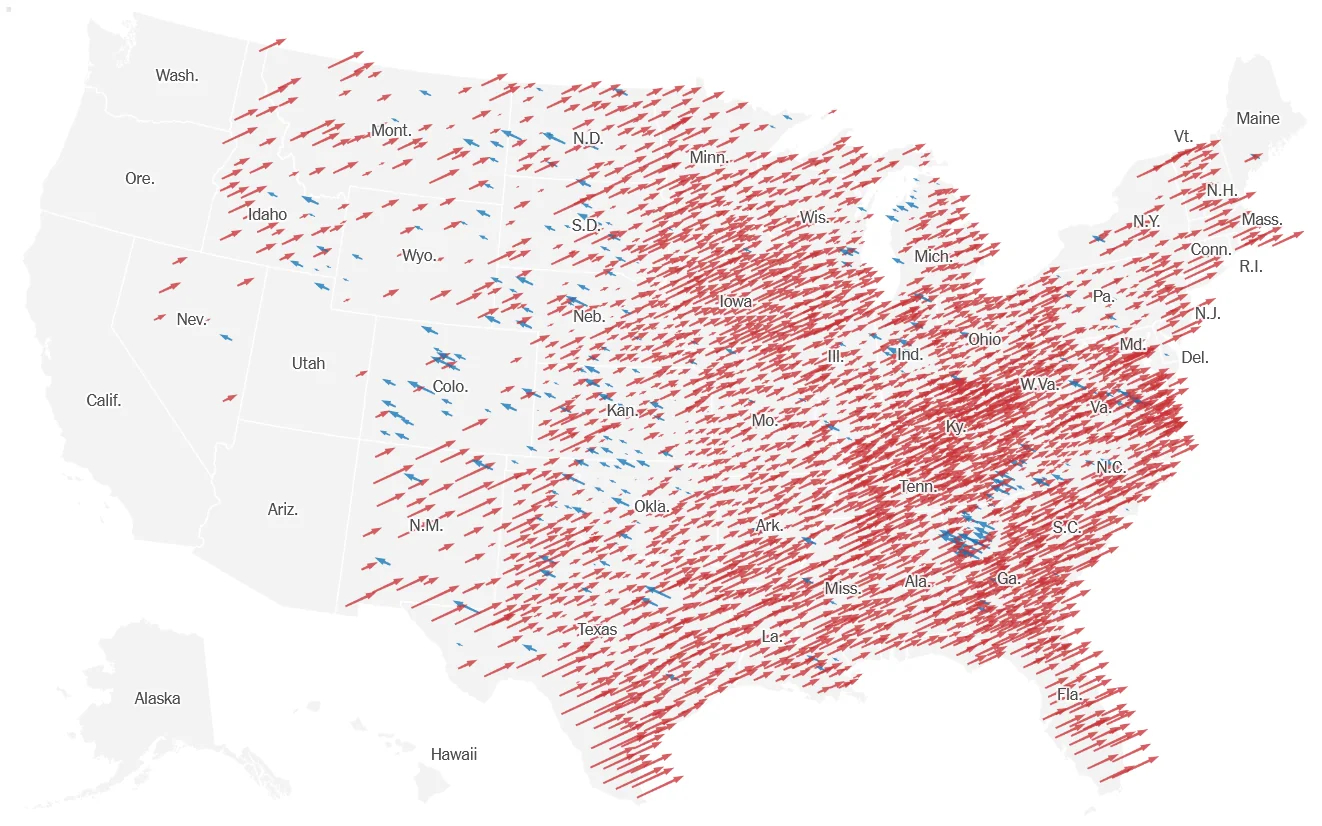
The image comes from the New York Times, and I was looking to find this but for the 2020 election but cannot find it. This election highlights the illusion that was 2020 due to Covid, the decrease in voter turnout is also extremely telling.
The next four years are going to be harrowing.
Added Later
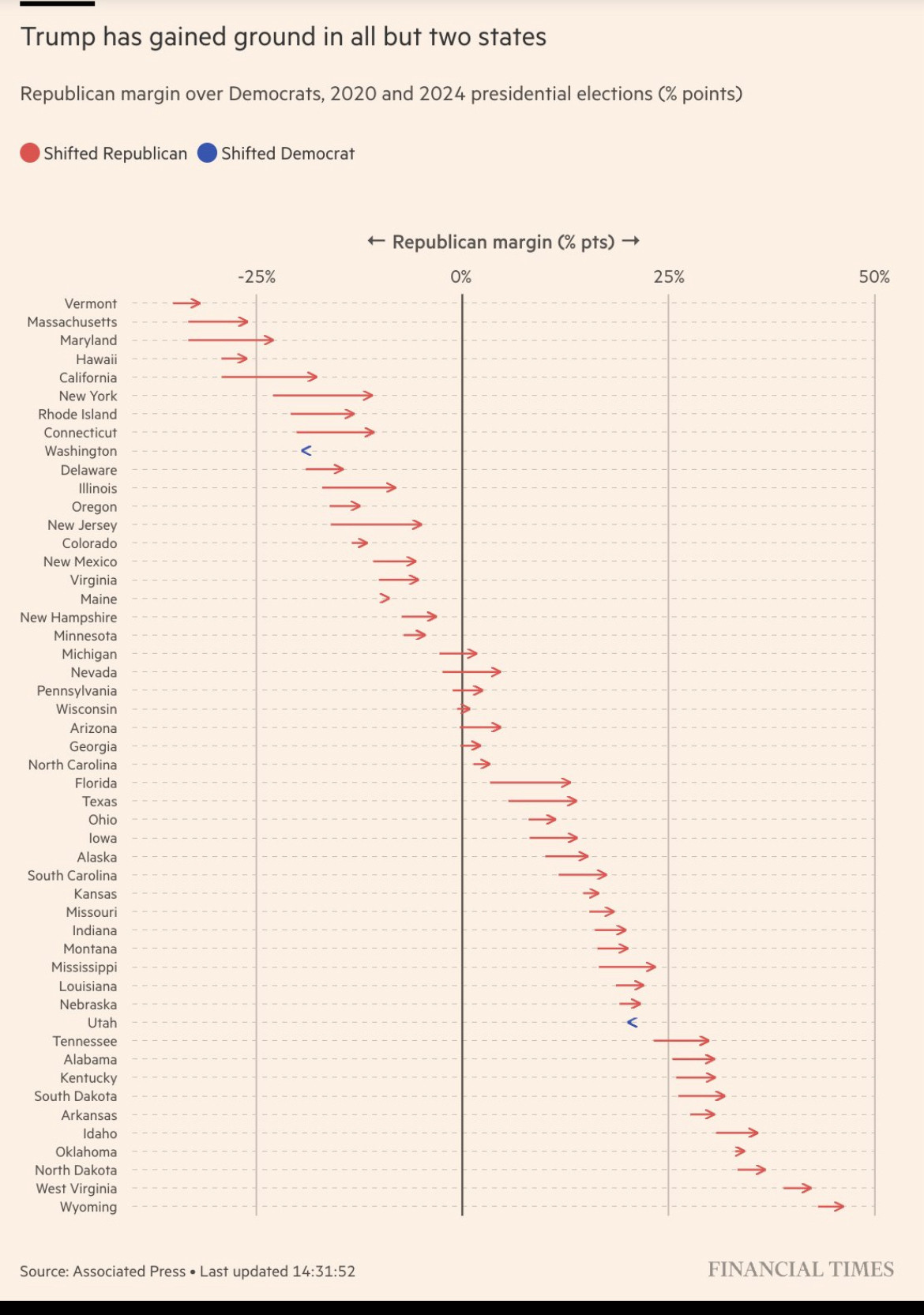
Just found this image online and this is very interesting to see as another visualization of the shift in this election. Fascinating that the only two states to shift more Blue were Washington and Utah.
|
So disappointing this wasn't a sweeping rejection of Trumpism. Even if she manages the win, the fact it continues to be this close is utterly sickening.
|
Ezra Klein and Jon Stewart
I listened to most of this interview on the drive into work this morning and quite enjoyed it. One thing that struck me is how Ezra comes into this wanting to discuss the right vs left and Jon multiple times redirects it to be about the capitalism machine and the media businesses which drive the wedge to their benefit.
|
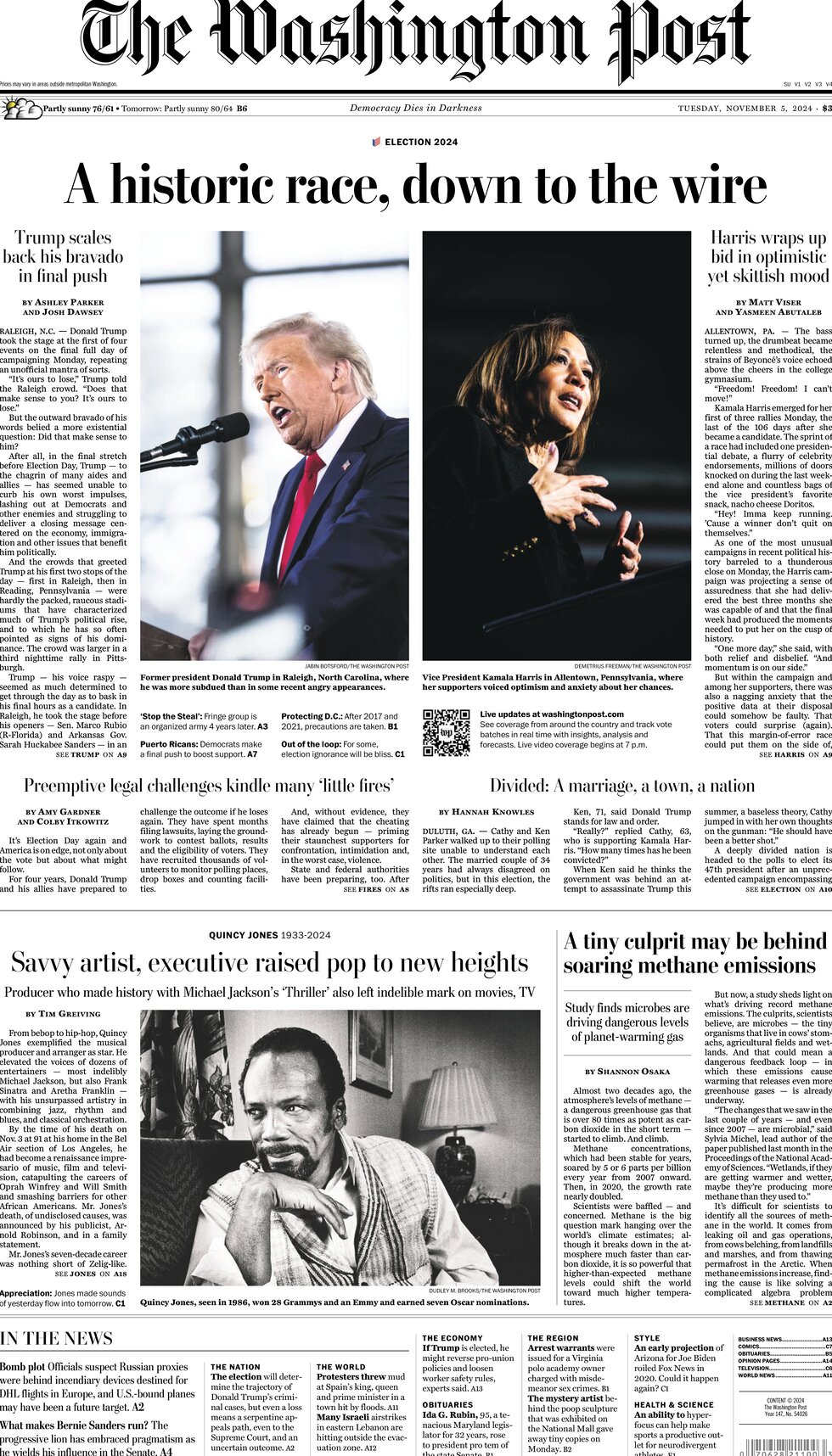
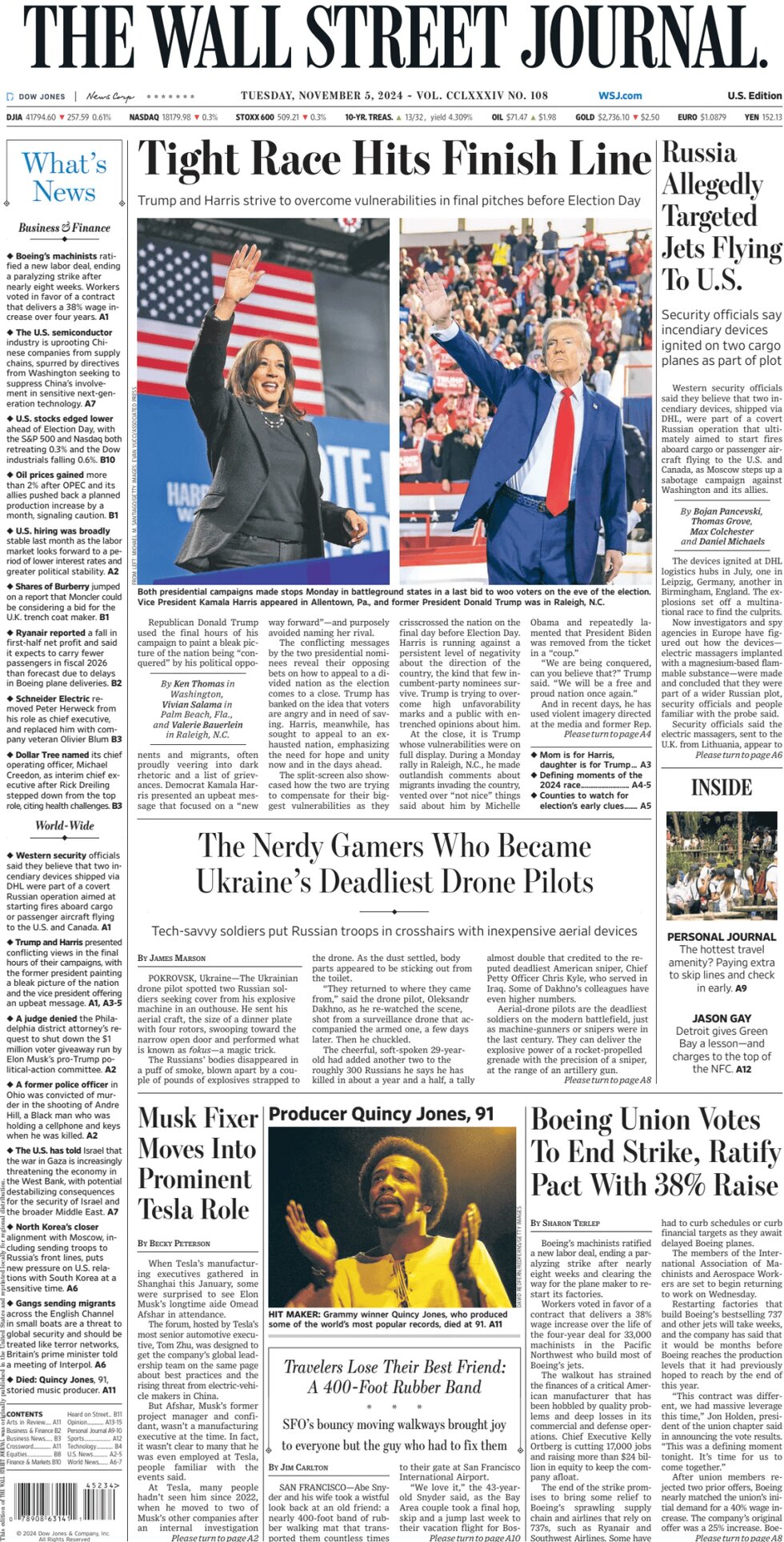
What European countries would vote for which candidate
Not a big surprise, but on this list, it isnt until you to get the Balkan states that the quantity flips majority to Trump.

|
