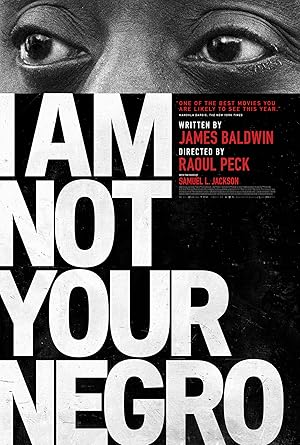
 I Am Not Your Negro (2016) - 5 out of 5 stars
James Baldwin: The story of the Negro in America is the story of America, and it is not a pretty story.
Here is a description of the movie, written by Jwelch5742 on IMDB:
In 1979, James Baldwin wrote a letter to his literary agent describing his next project, "Remember This House." The book was to be a revolutionary, personal account of the lives and assassinations of three of his close friends: Medgar Evers, Malcolm X and Martin Luther King, Jr. At the time of Baldwin's death in 1987, he left behind only 30 completed pages of this manuscript. Filmmaker Raoul Peck envisions the book James Baldwin never finished.
I admit struggling to find words for this film, as it is so important to tell stories which I have zero direct experience with. But it is a reminder that a movie which came out seven years ago about an intellectual who died almost forty years ago, and discusses the lives of three great men who died longer ago than that - is still timely and important today.
James Baldwin: Not everything that is faced can be changed. But nothing can be changed until it has been faced. History is not the past. It is the present. We carry our history with us. We are our history. If we pretend otherwise, we literally are criminals.

 |
|
A historical map of Sundown Towns in the US
Interesting to see the historical markers and upsetting to see so many of them across the map. An important bit of context is that the person who originally shared this online was pointing out there are still plenty of places in this country which are sundown towns and that they are not limited to the South. The link goes to the Twitter thread with more good links for further reading.
Going back to the map, Seattle here is historically a sundown town for Asians and Indigenous People, the site gives this historical context:
When Seattle incorporated in 1865, the city banned American Indians from living there, except as live-in domestic workers. When the city was reincorporated in 1869, the legal ban was lifted, and it may not have been effectively enforced, 1865-69. American Indians were still frequently harrassed [sic], however, and subject to segregation.
In the 1880s, white Seattle residents attempted to expel the city’s Chinese population. “A vigilante gang of whites marched on Chinatown one morning and at gunpoint gathered the Asian residents, herding them down to the train station. There the Asians were loaded onto freight cars and shipped off to Tacoma. Some eventually (and quietly) returned but most apparently did not…
"On February 7, 1886, a throng of workers rounded up virtually every Chinese in Seattle and herded them to the Ocean Dock at the foot of Main Street for passage out of town on a waiting steamer. The mob and its frightened charges were met at the pier by police and a contingent of the volunteer Home Guard. A stalemate ensued when territorial governor Watson Squire prevented the ship from leaving." Thus Seattle never quite became a sundown town vis-a-vis Chinese, at least not for longer than a few days. Many Seattle neighborhoods kept out African Americans, by tradition and force, and also by restrictive covenants, but as an entity, Seattle never prohibited blacks from living within the city limits.
I think this is perhaps even kind to Seattle. It has a very racist history which only broke from core institutional issues in the last fifty-sixty years.
As of the 2022 Census the demographics for King County (which I'll come back to my county's name in a moment):
| Race and Hispanic Origin | % |
|---|---|
| White alone | 63.5% |
| Black or African American | 7.4% |
| American Indian and Alaska Native | 1.0% |
| Asian | 21.7% |
| Native Hawaiian and Other Pacific Islander | 0.9% |
| Two or more races | 5.6% |
| Hispanic or Latino | 10.5% |
| White alone, not Hispanic or Latino | 55.% |
For comparison: I grew up in Orange County, Florida. Their census shows: 20% (+13%) Black or African American, 33% (+22.5%) Hispanic or Latino people, but less than 6% (-15.7%) Asian people.
Now, switching to King County, Washington and it's history.
King County was created prior to Washington becoming a state, and it was originally named after Vice President William R. King, who served under Pierce. In 1986 the county's council approved an effort to rename the namesake of the county to be for Martin Luther King Jr. because one of these people fought racism, and the other was a slave owner. I'll leave it as an exercise to the reader to guess which is which.
Fascinatingly the county did not have the power to make this name change, it has to be done by the state. So it wasn't until 2005 that the governor signed a bill which made this namesake change official.
The last topic I'll touch on this discussion as I make sure to shine light on the Seattle history, is a look at its racially restrictive covenants which limited property ownership by minorities.
From the link, a page from UW:
The language of segregation still haunts Seattle and cities and towns throughout Washington State. It lurks in the deeds of more than 30,000 homeowners in King County and at least 20,000 more in other counties. Look deep in the fine print. Many Queen Anne residents have this clause in their deeds: "No person or persons of Asiatic, African or Negro blood, lineage, or extraction shall be permitted to occupy a portion of said property."
Racial deed restrictions became common in the decades between 1910 and 1960. For most of that time, the restrictions were an enforceable contract and an owner who violated them risked forfeiting the property. Many neighborhoods prohibited the sale or rental of property to Asian Americans and Jews as well as Blacks. In 1968, Congress passed the Fair Housing Act, finally declaring it unlawful to discriminate on the basis of race or ethnicity in the sale or rental of housing. Although decades have passed since 1968, the shadow of these racist restrictions remains, shaping the demography of some neighborhoods, constraining access to homeownership for thousands of families who experienced generations of exclusion.
These exclusions were hardly unique to Seattle, but it is notable how it was only declared unlawful less than 70 years ago.
|
"Do you have a moral duty to watch the police beating of Tyre Nichols?"
A friend asked a similar question on Facebook yesterday.
Is watching it ghoulish voyeurism?
Or is not watching it tacit complicity in the status quo?
How do you feel about the answer, and why? I can't figure out where I stand.
This was my response:
I turn away from watching the video itself, but I read the responses and editorials about it. I have always shied away from watching death. As [name removed, another person in the thread] said, and I fully acknowledge, this is my cowardly privilege. I don't watch horror movies, I avoid almost all suspense, because it gets into my head and torments me for a long while after.
I already know how I feel about this, and the awfulness on display here. My feelings here are pegged already in the anger and sadness and frustration, and watching it won't do anything to drive those further in me.
The editorial on WaPo shows others are asking the same question. I especially appreciated this excerpt:
Allissa V. Richardson, a University of Southern California journalism professor who researches Black Americans' use of social media as journalism, said people should not feel a moral obligation to view violent records of important events.
Richardson said there is both power and risk in the ways that smartphones and social media regularly broadcast so much evidence of brutality to us.
"People should be very careful about consuming these videos casually through social media," Richardson said in an email. "For many Black Americans especially, it can be retraumatizing to see someone who looks like you or a loved one be brutalized this way."
Richardson also said that when violent moments grab our attention, we may conflate passive watching with action.
"Pressing play is not the same as pressing for tangible changes. Social media can make us forget that sometimes," she said.
|
"Inhumanity in Memphis"
I haven't brought myself to watch the video yet. I don't have to. Writers like this can tell me what I need to know.
Even before the city of Memphis released video Friday evening of the fatal beating of Tyre Nichols, it seemed the footage would be horrifying. Defense attorneys compared it to the Rodney King beating in 1991, a comparison that now rings true, but the Memphis police chief and head of the Tennessee Bureau of Investigation similarly said they were appalled by what they saw. Cops often remind critics that their job necessarily entails violence, so when seasoned law-enforcement officers react this way, it’s telling.
They were right to be appalled. Though the public might have started to become accustomed to the stream of de facto snuff films of people dying at the hands of police, this video is shocking, showing officers wantonly beating a 29-year-old Black man. If they did not intend to kill him, they showed little hesitation in beating him near to death and little remorse after they’d finished. Five officers have been fired, and all five have been charged with second-degree murder. All of them were part of a vaunted hot-spot policing unit called SCORPION, only established in 2021.
|
Derek Chauvin trying to get state charges dropped
An attorney for Chauvin will ask an appeals court Wednesday, Jan. 18, 2023, to throw out his convictions in the murder of George Floyd, arguing that numerous legal and procedural errors deprived him of his right to a fair trial. Court TV/AP hide caption
I am not a lawyer, but this seems pro forma going through the motions and trying to get things cleared because the appeal process exists and see if another judge will be more lenient.
|
"Why the Justice Department made a move in the police killing of Breonna Taylor"
About. Fucking. Time. The idea that police could make this sort of mistake and not suffer a criminal penalty is terrifying and saddening. I'm so glad this is happening.
|
 Some Links For the PNW and Seattle's Civil Rights and Racist History
The PNW is viewed as a liberal bastion in the USA these days, thanks to the population centers in our states. But that isn't the whole truth, and it hasn't always been that way. The rural parts of the state are still quite politically conservative and, worse, some areas actively foster white supremacist beliefs. Even the population centers haven't been liberal and civil rights minded until recent history.
Today is the 188th anniversary of the Oregon territory's anti-free black man law, but there are many more recent examples to contend with in this region's history. From the treatment of the local tribes and their citizens, to segregation and racism of other people, to the internment camps, and more.
Some additional reading:
On Jun 26, 1844: Oregon Territory Bans Free Black People
On June 26, 1844, the legislative committee of the territory then known as “Oregon Country” passed the first of a series of “Black exclusion” laws. The law dictated that free African Americans were prohibited from moving into Oregon Country and those who violated the ban could be whipped “not less than twenty nor more than thirty-nine stripes."
The Seattle Civil Rights Movement - Wikipedia's entry regarding Seattle's Civil Rights movement in the 1960s.
Seattle Civil Rights and Labor History (a UW project)
Seattle has a unique civil rights history that challenges the way we think about race, civil rights, and the Pacific Northwest. Civil rights movements in Seattle started well before the celebrated struggles in the South in the 1950s and 1960s, and they relied not just on African American activists but also on Filipino Americans, Japanese Americans, Chinese Americans, Jews, Latinos, and Native Americans. They also depended upon the support of some elements of the region's labor movement. From the 1910s through the 1970s, labor and civil rights were linked in complicated ways, with some unions and radical organizations providing critical support to struggles for racial justice, while others stood in the way.
Seattle's Ugly Past: Segregation in Our Neighborhoods
Newcomers to Seattle love the variety of neighborhoods. We’re a counterpane of livable places with modest and grand homes often tucked together in a green and pleasant landscape. It’s a residential smorgasbord of cultures, home styles and enclaves, from houseboats to high-rises, bungalows to classic boxes. But that excitement of choice wasn’t always there for everyone. For most of the 20th century, the city was restricted and segregated, if not literally gated.
|
A Letter from the Washington State Supreme Court After the Death of George Floyd (June 2020)
Dear Members of the Judiciary and the Legal Community:
We are compelled by recent events to join other state supreme courts around the nation in addressing our legal community.
The devaluation and degradation of black lives is not a recent event. It is a persistent and systemic injustice that predates this nation’s founding. But recent events have brought to the forefront of our collective consciousness a painful fact that is, for too many of our citizens, common knowledge: the injustices faced by black Americans are not relics of the past. We continue to see racialized policing and the overrepresentation of black Americans in every stage of our criminal and juvenile justice systems. Our institutions remain affected by the vestiges of slavery: Jim Crow laws that were never dismantled and racist court decisions that were never disavowed.
[...]
I either completely missed when this was published or had forgotten about it, nevertheless, I am thankful to live in a state where the highest court takes a proactive stance on pushing for social change and equality. Washington is far from a perfect state, and it has its share of white supremacy and problematic history (and current reality), but proactiveness like this is what furthers change.
Yesterday I was out with my wife walking around downtown Kent, the town outside of Seattle, I live in. And I was seeing the growing minority communities with a Kenyan restaurant and other Black-American and African migrant places which are finding homes here. It excited me. Growing up in the South I was used to a much more diverse population than what I found when we moved to Seattle, and I am hopeful the diversity will continue to grow.
The letter that I linked was brought to my attention by this article in the Seattle Times, "‘We’re not colorblind’: Two years after George Floyd, WA Supreme Court tries to chart a different path on race" - which highlights both the progress the state is making while citing a recent study which shows that there is still much to be done.
In the two years since their letter, the court has made efforts large and small, symbolic and concrete, trying to move toward a more just legal system. The court has overturned decades-old hateful precedents, with little public notice. It has thrown out laws, vacating tens of thousands of criminal convictions. It has ordered pay raises to thousands of immigrant farmworkers. In many cases, it has moved faster than both the state Legislature and the nation in barring practices that it considered unjust or racially discriminatory.
[...]
A report from Washington’s three law schools, issued last fall, found racial disparities at every level of the criminal legal system, from who gets stopped and searched by police, to who is arrested and convicted, to the length of sentences that are handed out. Advertising
The report did show some areas of improvement. The rate of Black people incarcerated in Washington fell by nearly half from 2005 to 2020, from about 2.5% of the Black population to about 1.3%. But a Black person in Washington is still 4.7 times more likely to be incarcerated than a white person.
“Race and racial bias continue to matter in ways that are not fair, that do not advance legitimate public safety objectives, that produce disparities in the criminal justice system, and that undermine public confidence in our legal system,” the report said.
The state also has a truly awful history in its treatment of the first people and tribes of Washington. The article goes on to highlight the work of a lawyer working to right past wrongs by the state for members of tribes exercising rights which should have been protected by the treaties that were signed and then ignored.
So, the battle for justice and rights continues. It won't stop. It can't stop. And it is heartening to see the diversity of the Washington Supreme Court and its desire to do just that.
The Washington state Supreme Court may be the most diverse high court in the country. Among the nine justices there is only one white man. There are seven women, four people of color, three Jewish justices, two lesbians, the court’s first Indigenous justice and a Black immigrant from Trinidad and Tobago.
|
Martin Luther King Day
Over ten years ago, closer to twelve now, Katie and I took a trip to D.C. I was attending a Drupal conference there for work (back when I was a full-time web developer) and we decided to take extra time and see the museums and landmarks.
I will forever remember what Katie wanted on this trip. She wanted a recording of King's "I Have a Dream" speech on her iPod, so she could sit on the steps of the Lincoln memorial and experience and imagine it. I can still see her clearly sitting on the steps in her coat, headphones on, listening to the words of the Reverend and tears silently falling down her cheeks.
The injustice that someone as great as him was murdered and not allowed to continue his work in driving social reform is a terrible tragedy. And it is crucial that people today not gloss over what today is meant to be - a day of remembering and honoring him for his work.
Two years ago, while visiting family in Memphis we went to the Civil Rights Museum which has been built in the motel and surrounding buildings of where he was murdered. It was eye opening for me, and educated me on a lot about the civil rights movement that I had no idea. Things that history class had glossed over or ignored completely.
It's important to understand the magnitude of effort it took to, essentially, turn the dial one or two notches on social injustice. They moved the needle. They changed things. But not completely, leaving more still to be done. It is a fight which requires more figures to stand up and speak out and fight back. Things we are seeing around us, from last year's protests and the riot at the capitol unveiling how many members of law enforcement side with a personality rather than the Constitution.
From the 'I Have a Dream' speech:
We have also come to his hallowed spot to remind America of the fierce urgency of now. This is no time to engage in the luxury of cooling off or to take the tranquilizing drug of gradualism.
Now is the time to make real the promises of democracy. Now is the time to rise from the dark and desolate valley of segregation to the sunlit path of racial justice. Now is the time to lift our nation from the quick sands of racial injustice to the solid rock of brotherhood. Now is the time to make justice a reality for all of God's children.
|
Rep. John Lewis on the first time he met MLK Jr.
Rep. John Lewis speaks on MLK's death:
[{embed}]https://www.youtube.com/watch?v=80jUWTBSOVs\[{/embed}]
|
