I am, somehow, less interested in the weight and convolutions of Einstein's brain than in the near certainty that people of equal talent have lived and died in cotton fields and sweatshops. ― Stephen Jay Gould

 |
|
Washington State and the KKK
The article earlier about the neo-nazi and Maine sent me to doing some more reading about Washington and its history for non-white people. One thing I came across was a mention of the City of Bellingham giving the leader of their KKK chapter the key to the city back in the 1920s.
[M]ost of the news coverage of the Klan in Whatcom county during 1924 focused on I-49, the anti-catholic school bill which was soundly defeated. But whereas most Klan chapters declined after that election, the Klan in Bellingham and Mount Vernon areas were strong enough to not only continue but draw large crowds at a series of public events that began with a meeting of over a thousand in Stanwood in 1924. And some believe that Marion A. Keyes, who was elected Mayor of Blaine in 1924, was a member of the Klan.
On September 26th, 1925, the “largest crowd that has ever assembled in the Lynden District,” estimated between 12,000 and 25,000 people, attended a rally of supposedly 750 members of the Ku Klux Klan at the Northwest Washington Fair Grounds.
And elsewhere on the site, there is a mention of the following:
Delegates to the Democratic Party's 1924 Convention from Washington State, Oregon, and Idaho unanimously opposed adding a plank to the Party Platform that would condemn Ku Klux Klan violence.
The democrats have changed so much since then, but Jesus what a thing to read.
|
Dunk tanks have a hugely racist origin
Discovered courtesy of a link from kottke, who in turn found it on bluesky.
The African dodger, also known as Hit the Coon, was a popular American carnival game from the late 19th century up to the mid-1940s. It involved an African-American man sticking his head out through a hole in a curtain and trying to dodge balls thrown at him. Hits were rewarded with prizes. People were seriously injured or reportedly even killed after being struck. In response to attempts to ban it, a less dangerous game was invented called the African dip, in which a person was dropped into a tank of water if a target was hit by a ball. Popular Mechanics noted in 1910 that African dodger had become "too old and commonplace" and was being replaced with dunk tanks, in which an African American would fall into a tank of water when a target was hit with a ball. The illustration accompanying the article shows a game labelled "Drop the Chocolate Drop" and is captioned "Amusing to All but the Victim".
Generally, the African Dip is recognized as overtly racist. One variant, at Chicago's Riverview amusement park, was named "Dunk the Nigger" until the early 1950s when it was renamed "African Dip". The NAACP protested the attraction in the 1940s, and it was eventually shut down in the mid-1950s.
|
There was a post which made the rounds, an article on Substack from a man who discusses his white nationalist beliefs and his disillusionment after moving to the Midwest. I can't bear to even link to the post. It's pure drivel.
He starts out discussing how he left white nationalism, but what the author means is that he stopped feeling it was necessary that he made it the defining feature of his personality, nor to go to the rallies, etc. He goes on and on about it, making it clear that he is still firmly rooted in it and just isn't driven to be politically active about it.
The segment which was getting traction was about him moving to the Midwest. But even then, people are laughing and I just shake my head. The guy was disillusioned because he felt superior to all the contented midwesterners, living simple lives without motivation to chase greater success or money. He even talked about them in racial terms, comparing them to Asians, and other "inferior" groups.
The article was repugnant and I feel sad that feelings like the author's are so common.
|
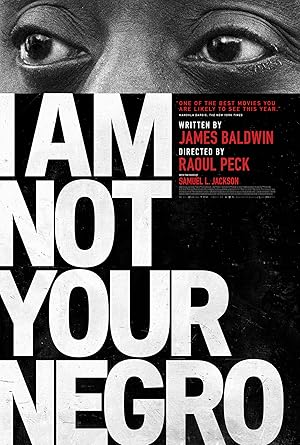
 I Am Not Your Negro (2016) - 5 out of 5 stars
James Baldwin: The story of the Negro in America is the story of America, and it is not a pretty story.
Here is a description of the movie, written by Jwelch5742 on IMDB:
In 1979, James Baldwin wrote a letter to his literary agent describing his next project, "Remember This House." The book was to be a revolutionary, personal account of the lives and assassinations of three of his close friends: Medgar Evers, Malcolm X and Martin Luther King, Jr. At the time of Baldwin's death in 1987, he left behind only 30 completed pages of this manuscript. Filmmaker Raoul Peck envisions the book James Baldwin never finished.
I admit struggling to find words for this film, as it is so important to tell stories which I have zero direct experience with. But it is a reminder that a movie which came out seven years ago about an intellectual who died almost forty years ago, and discusses the lives of three great men who died longer ago than that - is still timely and important today.
James Baldwin: Not everything that is faced can be changed. But nothing can be changed until it has been faced. History is not the past. It is the present. We carry our history with us. We are our history. If we pretend otherwise, we literally are criminals.
 |
|
A historical map of Sundown Towns in the US
Interesting to see the historical markers and upsetting to see so many of them across the map. An important bit of context is that the person who originally shared this online was pointing out there are still plenty of places in this country which are sundown towns and that they are not limited to the South. The link goes to the Twitter thread with more good links for further reading.
Going back to the map, Seattle here is historically a sundown town for Asians and Indigenous People, the site gives this historical context:
When Seattle incorporated in 1865, the city banned American Indians from living there, except as live-in domestic workers. When the city was reincorporated in 1869, the legal ban was lifted, and it may not have been effectively enforced, 1865-69. American Indians were still frequently harrassed [sic], however, and subject to segregation.
In the 1880s, white Seattle residents attempted to expel the city’s Chinese population. “A vigilante gang of whites marched on Chinatown one morning and at gunpoint gathered the Asian residents, herding them down to the train station. There the Asians were loaded onto freight cars and shipped off to Tacoma. Some eventually (and quietly) returned but most apparently did not…
"On February 7, 1886, a throng of workers rounded up virtually every Chinese in Seattle and herded them to the Ocean Dock at the foot of Main Street for passage out of town on a waiting steamer. The mob and its frightened charges were met at the pier by police and a contingent of the volunteer Home Guard. A stalemate ensued when territorial governor Watson Squire prevented the ship from leaving." Thus Seattle never quite became a sundown town vis-a-vis Chinese, at least not for longer than a few days. Many Seattle neighborhoods kept out African Americans, by tradition and force, and also by restrictive covenants, but as an entity, Seattle never prohibited blacks from living within the city limits.
I think this is perhaps even kind to Seattle. It has a very racist history which only broke from core institutional issues in the last fifty-sixty years.
As of the 2022 Census the demographics for King County (which I'll come back to my county's name in a moment):
| Race and Hispanic Origin | % |
|---|---|
| White alone | 63.5% |
| Black or African American | 7.4% |
| American Indian and Alaska Native | 1.0% |
| Asian | 21.7% |
| Native Hawaiian and Other Pacific Islander | 0.9% |
| Two or more races | 5.6% |
| Hispanic or Latino | 10.5% |
| White alone, not Hispanic or Latino | 55.% |
For comparison: I grew up in Orange County, Florida. Their census shows: 20% (+13%) Black or African American, 33% (+22.5%) Hispanic or Latino people, but less than 6% (-15.7%) Asian people.
Now, switching to King County, Washington and it's history.
King County was created prior to Washington becoming a state, and it was originally named after Vice President William R. King, who served under Pierce. In 1986 the county's council approved an effort to rename the namesake of the county to be for Martin Luther King Jr. because one of these people fought racism, and the other was a slave owner. I'll leave it as an exercise to the reader to guess which is which.
Fascinatingly the county did not have the power to make this name change, it has to be done by the state. So it wasn't until 2005 that the governor signed a bill which made this namesake change official.
The last topic I'll touch on this discussion as I make sure to shine light on the Seattle history, is a look at its racially restrictive covenants which limited property ownership by minorities.
From the link, a page from UW:
The language of segregation still haunts Seattle and cities and towns throughout Washington State. It lurks in the deeds of more than 30,000 homeowners in King County and at least 20,000 more in other counties. Look deep in the fine print. Many Queen Anne residents have this clause in their deeds: "No person or persons of Asiatic, African or Negro blood, lineage, or extraction shall be permitted to occupy a portion of said property."
Racial deed restrictions became common in the decades between 1910 and 1960. For most of that time, the restrictions were an enforceable contract and an owner who violated them risked forfeiting the property. Many neighborhoods prohibited the sale or rental of property to Asian Americans and Jews as well as Blacks. In 1968, Congress passed the Fair Housing Act, finally declaring it unlawful to discriminate on the basis of race or ethnicity in the sale or rental of housing. Although decades have passed since 1968, the shadow of these racist restrictions remains, shaping the demography of some neighborhoods, constraining access to homeownership for thousands of families who experienced generations of exclusion.
These exclusions were hardly unique to Seattle, but it is notable how it was only declared unlawful less than 70 years ago.
|
A Guardian Editorial points out the huge disparity in a hunt for five rich people in a submarine vs. drowning migrants at sea off Greece
Look, I hope the people in the sub get saved. But, also, the editorial is 1000% right.
A massive operation is under way to find and save a stricken vessel and its passengers. As time passes, anxious families and friends wait with growing fear. The US coastguard, Canadian armed forces and commercial vessels are all hunting for the Titan submersible, which has gone missing with five aboard on a dive to the wreck of the Titanic in the north Atlantic. The UK’s Ministry of Defence is also monitoring the situation.
It is hard to think of a starker contrast with the response to a fishing boat which sank in the Mediterranean last week with an estimated 750 people, including children, packed onboard. Only about 100 survived, making this one of the deadliest disasters in the Mediterranean. Greece and the EU blame people smugglers, who overcrowd boats and abuse those aboard them. But both have profound questions to answer about their own role in such disasters. Activists say authorities were repeatedly warned of the danger this boat faced, hours before it went down, but failed to act.
|
Decoration Day - The first Memorial Day
Back in 1996, David Blight, a professor of American History at Yale University, was researching a book on the Civil War when he had one of those once-in-a-career eureka moments. A curator at Harvard's Houghton Library asked if he wanted to look through two boxes of unsorted material from Union veterans.
"There was a file labeled 'First Decoration Day,'" remembers Blight, still amazed at his good fortune. "And inside on a piece of cardboard was a narrative handwritten by an old veteran, plus a date referencing an article in The New York Tribune. That narrative told the essence of the story that I ended up telling in my book, of this march on the race track in 1865."
The race track in question was the Washington Race Course and Jockey Club in Charleston, South Carolina. In the late stages of the Civil War, the Confederate army transformed the formerly posh country club into a makeshift prison for Union captives. More than 260 Union soldiers died from disease and exposure while being held in the race track's open-air infield. Their bodies were hastily buried in a mass grave behind the grandstands.
[...]
And then on May 1, 1865, something even more extraordinary happened. According to two reports that Blight found in The New York Tribune and The Charleston Courier, a crowd of 10,000 people, mostly freed slaves with some white missionaries, staged a parade around the race track. Three thousand Black schoolchildren carried bouquets of flowers and sang “John Brown’s Body.” Members of the famed 54th Massachusetts and other Black Union regiments were in attendance and performed double-time marches. Black ministers recited verses from the Bible.
If the news reports are accurate, the 1865 gathering at the Charleston race track would be the earliest Memorial Day commemoration on record.
The article goes on to highlight that he couldn't find any corroboration from other groups, but then later he gave a talk and had a woman come forward. The article explained there was an event,
After his book Race and Reunion was published in 2001, Blight gave a talk about Memorial Day at the Smithsonian National Museum of American History, and after it was finished, an older Black woman approached him.
"You mean that story is true?" the woman asked Blight. "I grew up in Charleston, and my granddaddy used to tell us this story of a parade at the old race track, and we never knew whether to believe him or not. You mean that's true?"
|
"There is nothing to remember"
Anil Dash is a tech entrepreneur in NYC. He also happens to be an American of middle eastern descent. Both mean that 9/11 held a very impactful place on his life.
He's written annually about 9/11 and what it has meant to him as an American and as someone with brown skin. His commentary also delves into how the day has been used both as a reason to be assaulted by someone else, as well as a talking point for politicians, and less about the truth and the actual event as it occurred.
|
Black man harassed by white woman in Seattle
So disappointing. I first heard about the video when an acquaintance of mine online tweeted about as proof why they wouldn't move to Seattle.
Katie and I have long discussed the comparatively low number of black people in Seattle compared to growing up in the South. And I've written past posts highlighting some of the region's history which actively discouraged diversity.
We still have a long way to go.
|
Quote from Toni Morrison on Racism
“The function, the very serious function of racism is distraction. It keeps you from doing your work. It keeps you explaining, over and over again, your reason for being somebody says you have no language and you spend twenty years proving that you do. Somebody says your head isn’t shaped properly so you have scientists working on the fact that it is. Somebody says you have no art, so you dredge that up somebody says you have no kingdoms, so you dredge that up. None of this is necessary. There will always be one more thing.”
|
 Some Links For the PNW and Seattle's Civil Rights and Racist History
The PNW is viewed as a liberal bastion in the USA these days, thanks to the population centers in our states. But that isn't the whole truth, and it hasn't always been that way. The rural parts of the state are still quite politically conservative and, worse, some areas actively foster white supremacist beliefs. Even the population centers haven't been liberal and civil rights minded until recent history.
Today is the 188th anniversary of the Oregon territory's anti-free black man law, but there are many more recent examples to contend with in this region's history. From the treatment of the local tribes and their citizens, to segregation and racism of other people, to the internment camps, and more.
Some additional reading:
On Jun 26, 1844: Oregon Territory Bans Free Black People
On June 26, 1844, the legislative committee of the territory then known as “Oregon Country” passed the first of a series of “Black exclusion” laws. The law dictated that free African Americans were prohibited from moving into Oregon Country and those who violated the ban could be whipped “not less than twenty nor more than thirty-nine stripes."
The Seattle Civil Rights Movement - Wikipedia's entry regarding Seattle's Civil Rights movement in the 1960s.
Seattle Civil Rights and Labor History (a UW project)
Seattle has a unique civil rights history that challenges the way we think about race, civil rights, and the Pacific Northwest. Civil rights movements in Seattle started well before the celebrated struggles in the South in the 1950s and 1960s, and they relied not just on African American activists but also on Filipino Americans, Japanese Americans, Chinese Americans, Jews, Latinos, and Native Americans. They also depended upon the support of some elements of the region's labor movement. From the 1910s through the 1970s, labor and civil rights were linked in complicated ways, with some unions and radical organizations providing critical support to struggles for racial justice, while others stood in the way.
Seattle's Ugly Past: Segregation in Our Neighborhoods
Newcomers to Seattle love the variety of neighborhoods. We’re a counterpane of livable places with modest and grand homes often tucked together in a green and pleasant landscape. It’s a residential smorgasbord of cultures, home styles and enclaves, from houseboats to high-rises, bungalows to classic boxes. But that excitement of choice wasn’t always there for everyone. For most of the 20th century, the city was restricted and segregated, if not literally gated.
|
A thread discussing the historical context of society's view of Star Wars
AKA why problematic white-centric views are so prevalent (though not the majority) of Star Wars fans
|
What the Capitol insurgency reveals about white supremacy and law enforcement
America should be honest about the fact that while many people are attracted to law enforcement because they truly want to protect and serve, there are others who seek out these jobs because they want to enforce white supremacist ideologies. Enforcing these ideologies means relegating pursuits of racial equity and criminalizing Blackness. For white supremacists, Blackness is viewed as an antithesis to white supremacy and anyone who actively and overtly embraces racial equity is a potential target of violence, even when the people doing the violence wear a badge.
|
Martin Luther King Day
Over ten years ago, closer to twelve now, Katie and I took a trip to D.C. I was attending a Drupal conference there for work (back when I was a full-time web developer) and we decided to take extra time and see the museums and landmarks.
I will forever remember what Katie wanted on this trip. She wanted a recording of King's "I Have a Dream" speech on her iPod, so she could sit on the steps of the Lincoln memorial and experience and imagine it. I can still see her clearly sitting on the steps in her coat, headphones on, listening to the words of the Reverend and tears silently falling down her cheeks.
The injustice that someone as great as him was murdered and not allowed to continue his work in driving social reform is a terrible tragedy. And it is crucial that people today not gloss over what today is meant to be - a day of remembering and honoring him for his work.
Two years ago, while visiting family in Memphis we went to the Civil Rights Museum which has been built in the motel and surrounding buildings of where he was murdered. It was eye opening for me, and educated me on a lot about the civil rights movement that I had no idea. Things that history class had glossed over or ignored completely.
It's important to understand the magnitude of effort it took to, essentially, turn the dial one or two notches on social injustice. They moved the needle. They changed things. But not completely, leaving more still to be done. It is a fight which requires more figures to stand up and speak out and fight back. Things we are seeing around us, from last year's protests and the riot at the capitol unveiling how many members of law enforcement side with a personality rather than the Constitution.
From the 'I Have a Dream' speech:
We have also come to his hallowed spot to remind America of the fierce urgency of now. This is no time to engage in the luxury of cooling off or to take the tranquilizing drug of gradualism.
Now is the time to make real the promises of democracy. Now is the time to rise from the dark and desolate valley of segregation to the sunlit path of racial justice. Now is the time to lift our nation from the quick sands of racial injustice to the solid rock of brotherhood. Now is the time to make justice a reality for all of God's children.
|
Rep. John Lewis on the first time he met MLK Jr.
Rep. John Lewis speaks on MLK's death:
[{embed}]https://www.youtube.com/watch?v=80jUWTBSOVs\[{/embed}]
|
